How are Chinese brands transforming the global auto market?
 Dubai, United Arab Emirates November 12 , 2026
 19 minute read

Chinese automakers have moved from the margins to the mainstream in barely ten years, thanks to low costs, fast innovation and a growing web of international partnerships. How far can China’s automotive rise go, and what – if anything – might slow it?
Sometimes, the unexpected happens. If someone had suggested a decade ago that around a third of the top 20 selling auto brands worldwide in 2026 would be Chinese in origin, they would have been met with disbelief.
Back then, in an industry dominated by established marques like Toyota, Volkswagen, Ford and Nissan, just one Chinese manufacturer cracked the global top 20: Chongqing-based Changan[1].
Skip forward to 2026, however, and no less than six Chinese brands feature among the biggest global sellers in the first half of the year: Geely, BYD, Chery, Changan, Great Wall Group and SAIC[2].
The runaway success of the Chinese auto industry over the past decade is electrifying in more ways than one.
How many cars are Chinese manufacturers selling each year?
The ascendancy of Chinese auto brands tallies with the growing prominence of the electric vehicle (EV) sector. In an ever-warming world, EVs have emerged as a key weapon in our fightback against carbon emissions and rising temperatures.
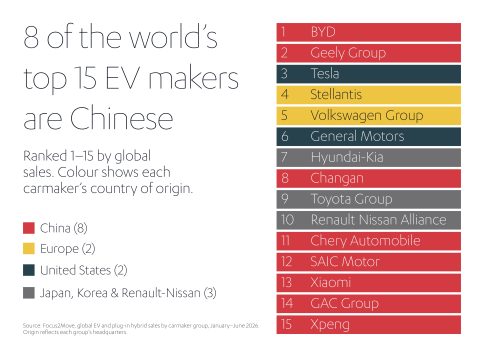
The shift in global auto sales becomes even more profound when one examines the EV sector in isolation. Here, no less than eight of the current top 15 manufacturers are Chinese in origin. Indeed, China can claim the two biggest-selling EV brands worldwide in the first half of 2026: Shenzhen-based BYD and Hangzhou-based Geely Group. These two global giants are joined on the top-sellers list by Changan, Xiaomi, SAIC, Chery, GAC Group and Xpeng[3].
The EV sector is increasingly charting its own course separate from legacy brands. While the automotive market as a whole is shrinking (-3.2% between January and September 2026), EV/PHEV sales are bucking the trend by growing 4% year-on-year[4]. It seems that consumers are responding to climate concerns and the energy crisis by accelerating their shift to electric powertrains.
This is a long-term pattern rather than a short-term anomaly. The International Energy Agency (IEA) estimates that EV sales are set to reach a record 23 million units in 2026, comprising almost 30% of all car sales globally. These predictions build on strong figures from 2025, when global EV sales grew 20% to surpass 20 million, or a quarter of all cars sold worldwide[5].
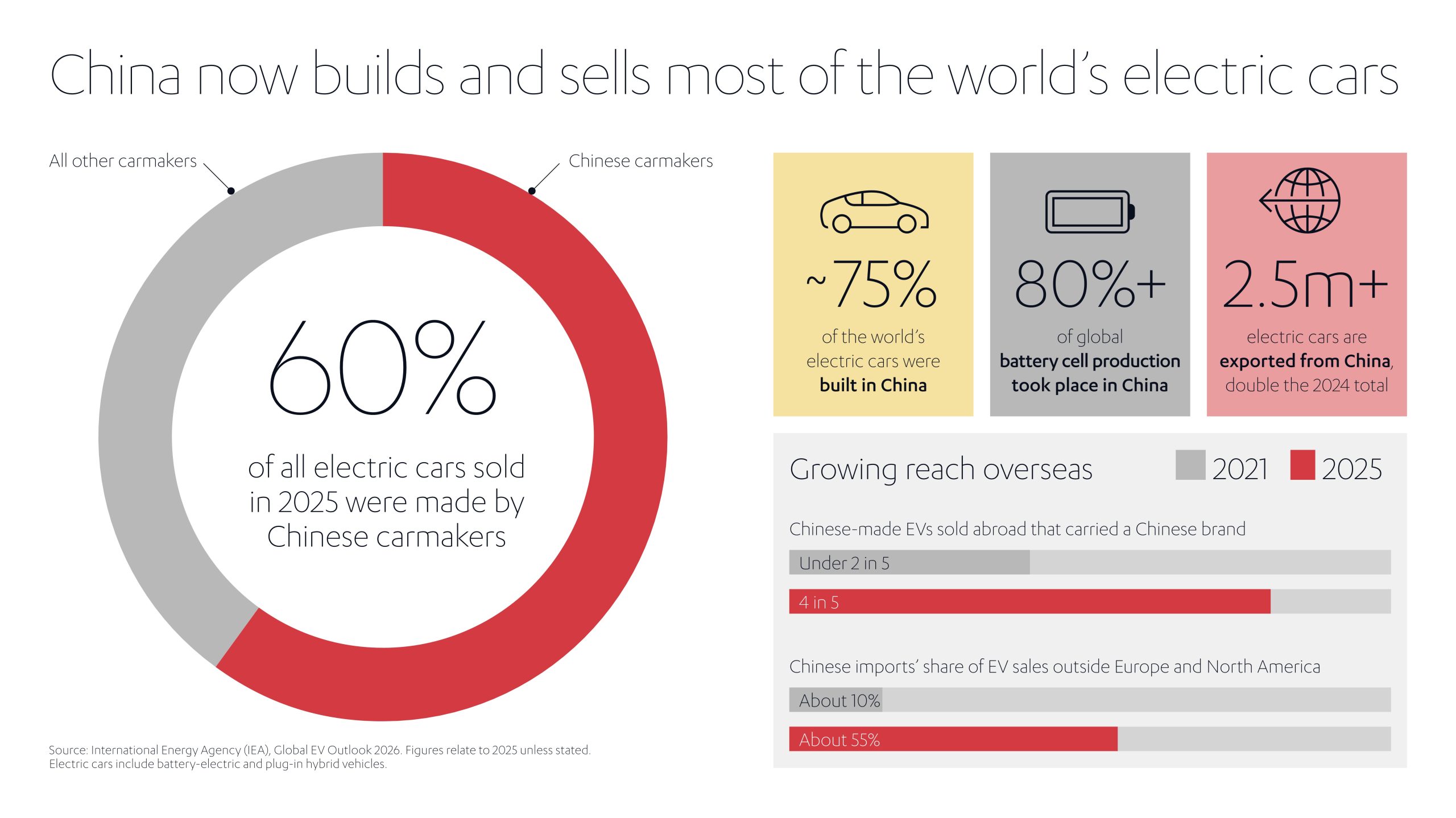
It is within this trend-bucking EV sector that China has gained apparently unstoppable momentum. In 2025 Chinese manufacturers supplied some 60% of all EVs sold worldwide, comfortably outpacing the industry’s traditional epicenters of Europe and North America, which each accounted for a comparatively slender 15%[6]. Nor is there any sign of this pace slowing in 2026, with Chinese OEMs including SAIC (+102.5%), Chery (+17.6%) and Xiaomi (+14.9%) all achieving notable EV sales growth[7].
China has become a major auto player in a relatively short space of time, and the rest of the world is struggling to keep up.
CASE STUDY – BYD’s RAPID RISE: 1995: BYD is founded in Shenzhen as a rechargeable-battery manufacturer. 2005: The company launches its first self-developed production car, the F3, establishing an auto business alongside its battery operations. 2008: BYD introduces the F3DM, one of the world’s first mass-produced plug-in hybrid cars, followed one year later by its first fully-electric battery vehicle, the BYD e6. 2010: BYD begins its international expansion, initially focusing on electric buses and taxis. 2022: BYD sells more than 1.86 million new energy vehicles (NEVs), cementing its position as a major force in China’s rapidly expanding EV market, and securing a place at number 212 on the Fortune Global 500 list the following year. 2023: BYD sales exceed 3 million vehicles globally, becoming one of the world’s top 10 carmakers for the first time, with exports surging to 243,000 vehicles across more than 70 countries. 2024: BYD sales climb to 4.27 million NEVs, while the company expands into 100+ countries and regions. 2025: BYD reports 4.6 million NEV sales in 2025, illustrating how this once predominantly Chinese manufacturer has rapidly acquired a global footprint.
How has China become so dominant in the global auto market?
Chinese auto manufacturers are now recognized globally for their technical aptitude across key disciplines: Batteries, design and software development.
All-purpose Chinese tech companies such as Xiaomi, Huawei and Alibaba have joined the auto space, their vast research and development capabilities giving them a leading edge in a notoriously tech-driven and fast-moving industry.
By some estimates it is almost a third cheaper to build a small electric SUV in China than in more developed nations
State support has been crucial. The Chinese government is believed to have invested tens of billions of dollars into EV and battery manufacturing in recent years alone. Lower battery costs and robust supply chains mean that, by some estimates, it is almost a third cheaper to build a small electric SUV in China than in more developed markets. In a subdued global economy, where people are timing their big-ticket purchases carefully, the financial case for buying Chinese is increasingly compelling[8].
Productivity and innovation go hand in hand. At Xiaomi’s factory, near Beijing, a new finished car exits the production line every 76 seconds. At XPeng’s Guangzhou headquarters, engineers are envisaging a whole new smart tech ecosystem, investing in flying cars and robots alongside EVs. At Nio’s Hefei plant, much of the manufacturing process is now fully automated and can operate with minimal human involvement[9]. Geely, meanwhile, is tackling issues of range anxiety and recharge times by developing AI-powered ultra-fast charging system that can bring a battery from 10% to 70% in under five minutes, and to 97% in under nine minutes[10].
Even Western manufacturers are exploiting the inarguable economics of producing cars in China. BMW’s electric Mini is made in China ready for export overseas, while American EV pioneer Tesla also uses China for building its Model 3s bound for Europe.
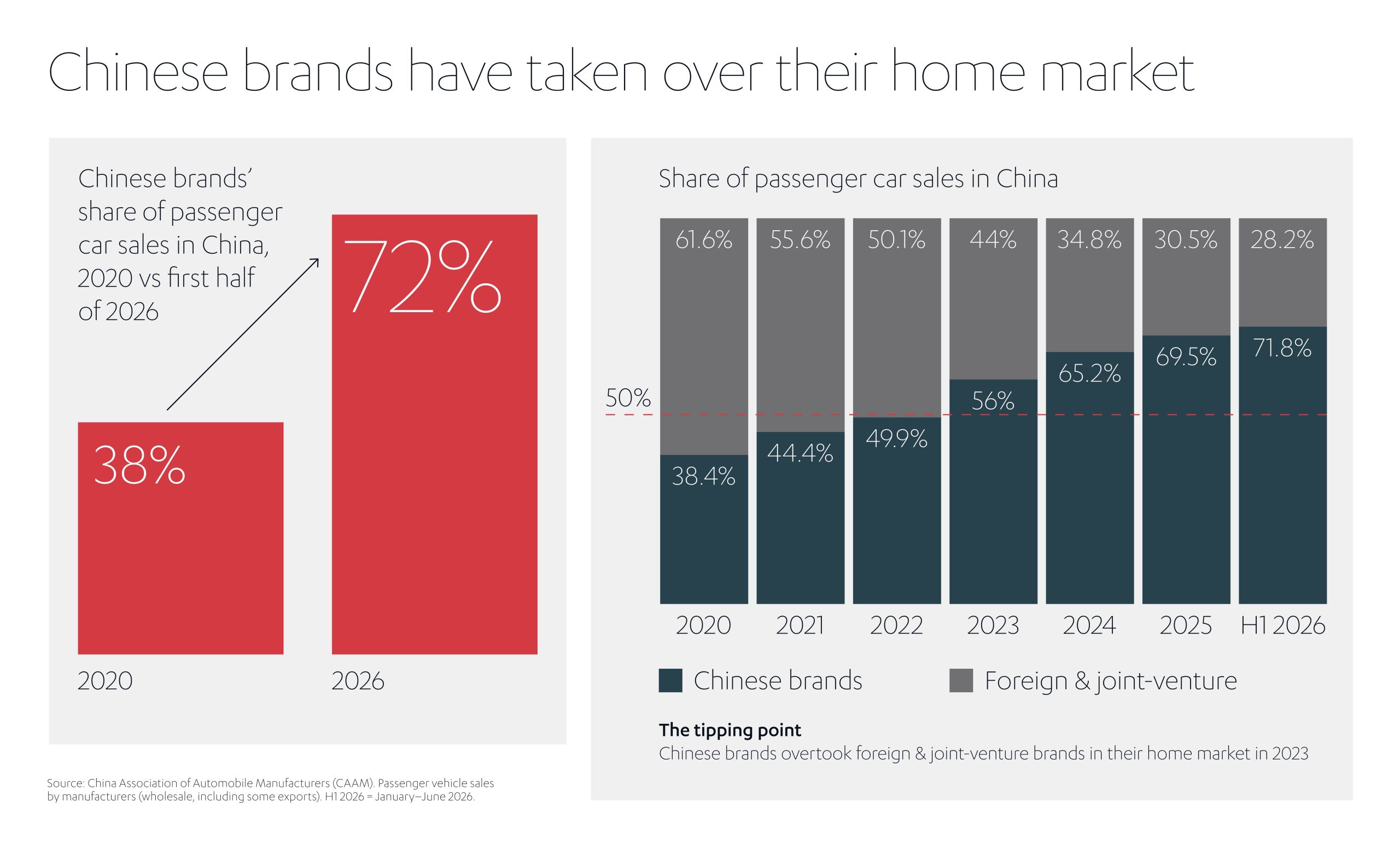
Ironically, these foreign legacy brands are struggling in China itself. In 2020, Chinese brands accounted for just 38% of passenger car sales in China; by the first half of 2026, that share had risen to 72%, according to the China Association of Automobile Manufacturers. Nor is the trend exclusive to budget brands[11]. Sales of the Maextro S800 luxury sedan developed by JAC Group and Huawei now outpace the combined sales of premium imports like the Porsche Panamera and the BMW 7 series[12].
When it comes to influence in the global auto market, longstanding hierarchies are evolving:[13]
- Stellantis, owner of well-known brands like Peugeot, Citroen, Fiat, Opel and Chrysler, owns a 30% stake in Chinese EV brand Leapmotor, whose vehicles it introduced into Europe in 2025.
- Volkswagen is paying XPeng some US$ 700 million for access to its autonomous driving systems and software architecture.
- Traditional marques such as Ford, Toyota and Nissan are all growing their R&D presence in China, while considering whether to produce Chinese-designed vehicles in overseas factories.
- The Abdul Latif Jameel network of diversified businesses, among the world’s largest Toyota distributors, have partnered with Chinese EV brands including BYD, Geely, SAIC’s MG Motor, GAC Motors’ GAC and AION brands; Geely’s Farizon and Geely Auto brands and most recentlu OMODA-JAECOO to distribute vehicles in specific markets outside China.
- Chinese automakers such as SAIC, BYD, JAECOO and Chery are successfully penetrating markets worldwide, including Europe, despite elevated EU tariffs.
With rapid product development cycles, low manufacturing costs, a sophisticated battery supply chain and vertically-integrated technology, China has become a leading player in the ultra-competitive auto market in a short space of time. Against this backdrop, how have different countries responded to the influx of Chinese autos?
Can Chinese automakers reshape Europe’s car market?
Chinese automakers are becoming an increasingly significant presence in Europe – despite the region’s efforts to protect domestic auto industries. Chinese brands accounted for more than 9% of EU car sales in the first half of 2026, a striking rise from just 3% as recently as 2023[14].
Chinese brands accounted for more than 9% of EU car sales in the first half of 2026, a striking rise from just 3% as recently as 2023
This shift is putting established European manufacturers under new pressure, particularly in the EV sector. Chinese brands are growing in reputation, balancing cutting-edge technology with low pricing. The EU has responded by imposing additional duties on Chinese EVs since 2024, ranging from 7.8% to 35.3% (on top of the basic 10% import tariff) depending on brand[15].
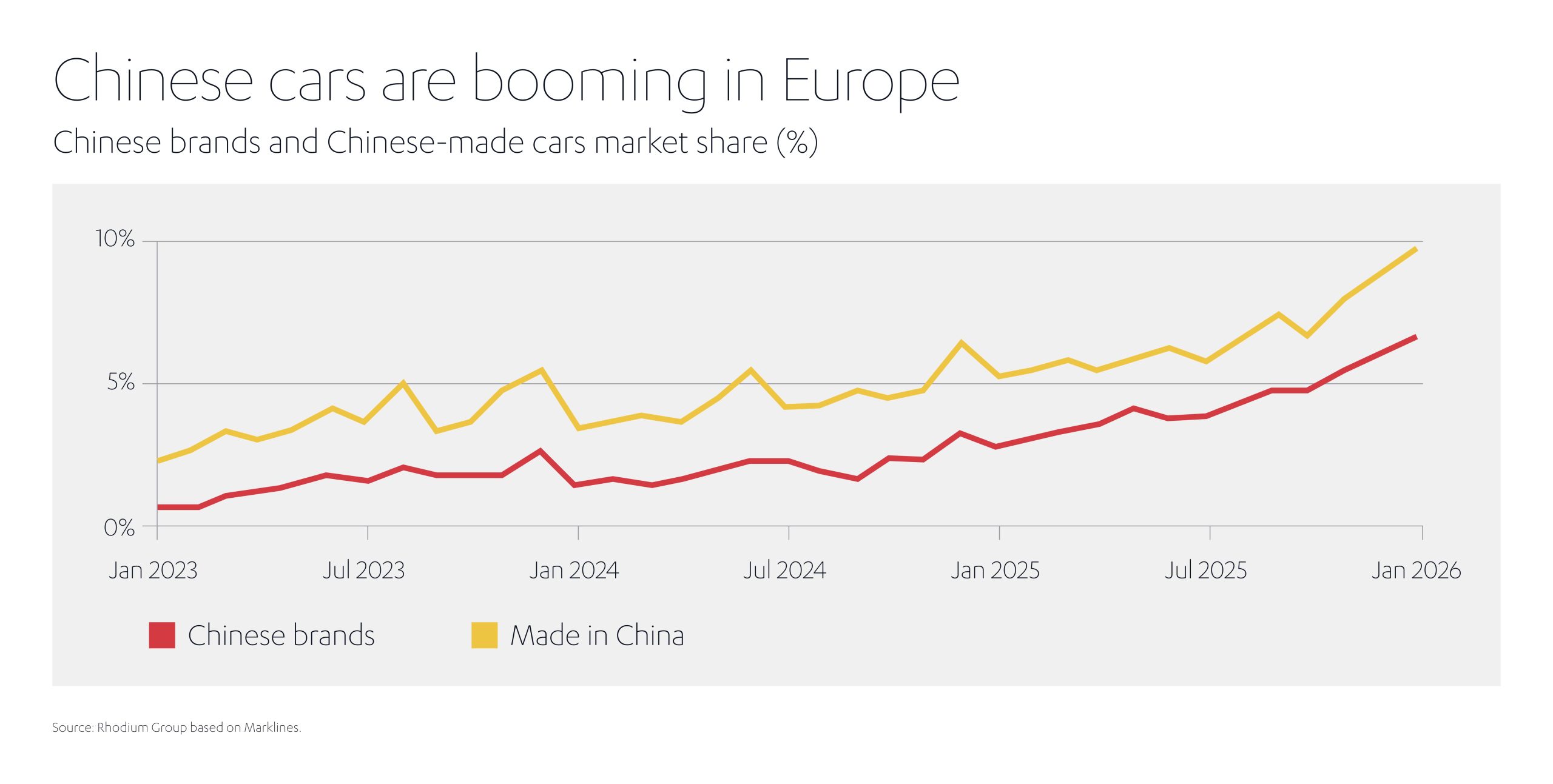
While the tariffs had a short-term impact on Chinese EV sales in Europe, such measures are only delaying their continued expansion. With hybrids and internal combustion engine (ICE) models exempt from the additional duties, Chinese imports to Europe are soaring, achieving 62% year-on-year growth in the first quarter of 2026[16].
Chinese brands appear destined to become a mainstay of European markets, with BYD building a new factory in Hungary[PS1] and expected to unveil a second production site soon[17]. Research suggests Chinese brands could claim at least 16% of car sales in Europe by the end of the decade[18].
Are Chinese carmakers succeeding in the Middle East?
The Middle East is emerging as an important market for Chinese automakers, particularly as Gulf countries invest in electrification. The Middle East’s vehicle market remains relatively open to new entrants. EV sales in the region reached around 75,000 in 2025, up more than 40% year-on-year[19]. The UAE accounted for almost half of these regional sales, with Saudi Arabia and Qatar together representing almost 45% of demand.
Chinese manufacturers are increasingly prominent in the Middle East. BYD, which entered the region in 2022, had captured around 60% of the EV market by 2025, compared with roughly 15% for Tesla[20].
Simultaneously, governments in Saudi Arabia and the UAE are investing heavily in charging infrastructure and new-energy mobility. Saudi Arabia is working with EVIQ to expand the country’s EV charging network, targeting 5,000 charging stations by 2030[21]. The government wants 30% of all vehicles in Riyadh to be electric by the end of the decade. Dubai now has more than 1,860 charging points and 23,600 registered users[22].
Chinese companies are also gaining a foothold in commercial transport. Qatar, for example, electrified 70% of its public bus fleet between 2021 and 2023 through a partnership with Chinese manufacturer Yutong[23].
Can Chinese EVs help Africa sideline damaging ICE engines?
EV adoption across Africa so far remains sluggish, at around 25,000 units in 2025, with Egypt, Morocco and South Africa accounting for almost 70% of these sales. However, Chinese automakers are commanding an outsized slice of that market, with BYD increasing its market share to 35% in 2025 from just 4% two years earlier[24].
Given the challenging terrain, long driving distances and underdeveloped infrastructure, Chinese manufacturers are finding success in Africa with electric heavy-duty vehicles
Given the challenging terrain, long driving distances and underdeveloped infrastructure across much of Africa, Chinese manufacturers are finding success with electric heavy-duty vehicles. BYD is supplying electric buses to South Africa, while Chinese manufacturers are expanding their commercial vehicle offerings across other emerging markets[25]. It is hoped that the appetite for privately-owned EVs will accelerate further as the region upgrades its charging infrastructure and improves the reliability of its electricity supply.
Will tariffs keep Chinese autos out of USA showrooms?
In North America, Chinese autos have made comparatively little impact on consumers due to trade measures and substantial domestic EV production. The current US regime introduced a 100% tariff on Chinese EVs in 2024, and since March 2025 new rules have banned the import of certain in-vehicle software from China[26].
South of the border in Mexico, the market has proved considerably more receptive to Chinese vehicle technology. In the first nine months of 2026, sales of Chinese autos in Mexico leapt 30%, from 107,712 to 137,525 units, now cornering 17% of the overall vehicle market[27].
Chinese manufacturers are now exploring local production as a means of serving the domestic market in Mexico. In 2026, BYD and Geely were among the leading bidders to purchase the former Nissan-Mercedes-Benz plant in Aguascalientes, with capacity for around 230,000 vehicles a year[28].
Can anything derail China’s growing dominance of the global car market?
China has massive capacity for vehicle production, potentially capable of satisfying more than half of the global demand for autos. Some industry watchers have even speculated that China is surpassing the USA as the epicenter of the world’s auto industry.
Yet is China’s continued rise inevitable?
Apart from protectionist duties in major markets such as the USA and Europe, pressures both internal and external may yet curtail momentum.
Demand for lithium, critical for EV batteries, rose almost 30% in 2024 – lithium could slide into deficit during the 2030s
China’s leadership in the EV sector also means competition for raw materials. Demand for lithium, critical for EV batteries, rose almost 30% in 2024, according to the IEA[29].
Lithium could slide into deficit during the 2030s, while copper could face a potential 30% supply shortfall in as little as a decade’s time.
Chinese manufacturers also face the challenge of raising their profiles – and establishing consumer trust – in markets to which they are relatively new.
FACT BOX – CYBERSECURITY – Geopolitical tensions could yet complicate the trajectory for Chinese manufacturers. As cars become increasingly connected, governments are vigorously scrutinizing the security implications of Chinese-made vehicles and the data they collect. An EU cybersecurity assessment of connected vehicles has already flagged up potential espionage and security risks. UN regulations, meanwhile, oblige manufacturers to have a Cybersecurity Management System, to carry out vehicle-specific risk assessments, and to introduce appropriate counter-hacking or data-mining measures.
Logistics present further pressures; establishing a cohesive dealer, servicing and spare-parts network is expensive and time-consuming. Concerns have also arisen over residual values. Leasing companies need confidence that vehicles will retain sufficient value at the end of a contract period, something that is difficult to demonstrate for new marques from emerging markets like China.
Regulatory fragmentation adds another layer of complexity. Safety, emissions and technical standards differ between markets, forcing manufacturers to adapt vehicles and processes for each jurisdiction. This can be financially challenging for newer brands compared to legacy rivals which have been straddling multiple markets for decades.
None of these barriers are insurmountable. Indeed, Chinese EV manufacturers are increasingly responding through local factories, partnerships and distribution networks. Some of the most productive of these relationships are with mobility specialists from the private sector.
Are private sector partnerships helping Chinese auto brands expand worldwide?
Recognizing their rapid rise in quality and cost competitiveness, Jameel Motors, the international mobility brand and part of the Abdul Latif Jameel network of diversified businesses, has entered a range of distribution agreements with Chinese auto brands globally.
In July 2025 Jameel Motors signed a distribution agreement with Geely Auto in Italy, a new market entry for both brands. Launch vehicles included the Geely EX5, a next-generation all-electric SUV, and a plug-in Super Hybrid SUV. Italy is one of Europe’s hottest markets for new energy vehicles (NEVs), with sales achieving a 132% year-on-year increase in the first half of 2025[30].
Jameel Motors and Geely are also teaming up in Australia, with a distribution agreement for the Farizon commercial vehicle brand. The deal launched with the born-electric Farizon SV cargo van, alongside H9E 4.5T and 8T truck models. The range caters to a growing demand for commercial vehicles in Australia and supports the country’s long-term vision of carbon neutrality.
In the UK, meanwhile, Jameel Motors has signed a joint venture agreement with GAC International, one of China’s major carmakers, to distribute EVs including the AION V SUV and AION UT hatchback. The deal expands Jameel Motors’ existing portfolio in the UK, where it also distributes the electric commercial vehicle brand Farizon Auto.
Jameel Motors is also targeting South Africa, with an agreement to distribute NEVs, SUVs, sedans and pickups on behalf of China’s Changan Automobile. South Africa is the largest vehicle market in Africa and EVs are emerging as an increasingly popular option. As of September 2026, South Africa recorded 16,289 NEV sales so far this year – an 88% increase on the same period in 2025[31].
In addition, Jameel Motors has secured a distribution agreement for GAC motors in Poland, where it will distribute the AION and the Hyptec, two of GAC’s main passenger car brands. Poland is one of the fastest-growing EV markets in Europe, with sales growing 102% in 2025 over the previous year[32].
It is a similar story in the MENA region, where Jameel Motors has further expanded its reach via distribution deals with Chinese automakers covering the UAE, Iraq and Morocco.
The huge appetite for Chinese brands globally suggests that the world’s traditional automobile centers have a new geographical rival to contend with. One that looks set to flourish further in the coming years.
Will Chinese autos become a mainstay of global mobility market?
The rise of China as a global auto hub, fueled by remarkable adoption rates of EVs worldwide, is universally acknowledged.
Ford chief executive Jim Farley has warned that legacy brands are “in a fight for our lives” as Chinese rivals continue to proliferate[33]. IEA executive director Fatih Birol has noted that declining battery costs, alongside policy responses to the global energy crisis, will provide yet further momentum for global EV markets in the near future[34].
“Chinese EV makers are beginning to reshape the geography, economics and competitive dynamics of the global auto industry ecosystem” – Jasmmine Wong, Chief Executive, Jameel Motors
With competitive advantages assured, China must now mature from simply exporting cars to establishing a durable automotive presence globally. Chinese automotive technology and capital is already becoming deeply embedded within regional supply chains through factories, joint ventures, battery plants and licensing, all helping to encourage the share of climate-friendly EVs in the vehicle market worldwide.
“Chinese EV makers are no longer simply exporting low-cost cars – they are beginning to reshape the geography, economics and competitive dynamics of the global auto industry,” says Jasmmine Wong, Chief Executive, Jameel Motors. “Chinese autos are proving pivotal in making clean, green motoring affordable to the masses. Such innovations mean that communities will be able to remain mobile, while helping to avert the world’s looming environmental crisis.”
CHINESE AUTOS – FIVE FAST FACTS:
Q: How fast are Chinese brands growing in prominence worldwide?
A: In the space of a decade, Chinese autos have grown from occupying a single place on the list of top 20 auto brands globally, to six. For EVs the pattern is even more pronounced, with eight of the current top 15 manufacturers being Chinese in origin.
Q: How dominant is China becoming in the electric vehicle sector?
A: In 2025 Chinese manufacturers supplied some 60% of all EVs sold worldwide, comfortably outpacing the industry’s traditional centers of Europe and North America, which each accounted for 15%.
Q: Are sales in the China-led EV market declining, in line with auto sales in general?
A: No they are not. While the automotive market as a whole is contracting 3.2% in 2026, EV sales are bucking the trend by growing 4%.
Q: Are foreign brands being squeezed out of China’s own auto market?
A: Chinese brands this year account for 68% of the domestic car market, a steep rise from just 36% as recently as 2020.
Q: Are EU tariffs slowing the adoption of Chinese cars in Europe?
A: Not really. Chinese brands accounted for more than 9% of EU car sales in the first half of 2026, a striking rise from just 3% in 2023, despite duties and tariffs on vehicles from China climbing as high as 45%.
[1] https://www.focus2move.com/world-cars-brand-ranking-2016/
[2] https://www.focus2move.com/world-car-group-ranking/
[3] https://www.focus2move.com/world-car-group-ranking/
[4] https://www.focus2move.com/world-car-group-ranking/
[5] https://www.iea.org/news/close-to-30-of-cars-sold-this-year-are-set-to-be-electric-as-countries-and-consumers-respond-to-energy-crisis
[6] https://www.iea.org/news/close-to-30-of-cars-sold-this-year-are-set-to-be-electric-as-countries-and-consumers-respond-to-energy-crisis
[7] https://www.focus2move.com/world-car-group-ranking/
[8] https://www.bbc.co.uk/news/articles/c4g8vg72z43o
[9] https://www.bbc.co.uk/news/articles/c4g8vg72z43o
[10] https://newsroom.geely.com/geely-auto-group-ultra-fast-ai-powered-geely-smart-charging
[11] https://eu.36kr.com/en/p/3916077131623811
[12] https://www.bbc.co.uk/news/articles/c4g8vg72z43o
[13] https://www.bbc.co.uk/news/articles/c4g8vg72z43o
[14] https://www.euronews.com/my-europe/2026/09/17/germany-turns-on-brussels-as-chinese-car-sales-on-track-to-exceed-1m-in-2026
[15] https://www.reuters.com/business/autos-transportation/eu-slaps-tariffs-chinese-evs-risking-beijing-payback-2024-10-29/
[16] https://rhg.com/research/dont-stop-me-now-chinese-cars-are-having-a-good-time-in-europe/
[17] https://www.reuters.com/world/china/byd-will-eventually-need-three-assembly-plants-one-battery-factory-europe-2026-09-16/
[18] https://www.forbes.com/sites/neilwinton/2026/07/18/chinese-pressure-on-european-automakers-intensifying-as-eu-hesitates/
[19] https://www.arabnews.com/business/saudi-arabia-powers-sustainability-race-as-ev-sales-in-me-surge-40-2645170
[20] https://www.arabnews.com/business/saudi-arabia-powers-sustainability-race-as-ev-sales-in-me-surge-40-2645170
[21] https://www.evinfrastructurenews.com/emobility/vision-2030-eviq-nhc-saudi-arabia
[22] https://dewa.gov.ae/en/about-us/media-publications/latest-news/2026/1/he-saeed-mohammed-al-tayer
[23] https://www.iea.org/reports/global-ev-outlook-2025/trends-in-heavy-duty-electric-vehicles
[24] https://www.marketscreener.com/news/chinaa-s-byd-captures-35-of-africa-ev-market-as-latecomer-rival-tesla-bets-on-morocco-ce7f5ddfda8af027
[25] https://www.bloomberg.com/news/videos/2025-04-13/byd-powers-south-africa-s-large-scale-electric-bus-fleet-video
[26] https://finance.yahoo.com/economy/policy/articles/us-bans-chinese-evs-could-153500743.html
[27] https://www.reuters.com/business/autos-transportation/chinese-car-sales-mexico-surge-despite-new-tariffs-2026-07-20/
[28] https://www.reuters.com/business/autos-transportation/seeking-mexico-foothold-chinas-byd-geely-bid-buy-car-plant-2026-02-12/
[29] https://www.iea.org/reports/global-critical-minerals-outlook-2025/executive-summary
[30] https://jameelmotors.com/en/news/jameel-motors-and-geely-auto-to-enter-italian-market-with-new-energy-passenger-vehicles/
[31] https://electricdrives.tv/south-african-ev-sales-reach-record-highs-in-2026-in-turning-point-for-adoption/
[32] https://alternative-fuels-observatory.ec.europa.eu/general-information/news/polands-electric-vehicle-revolution-full-2025-analysis
[33] https://www.bbc.co.uk/news/articles/c4g8vg72z43o
[34] https://www.iea.org/news/close-to-30-of-cars-sold-this-year-are-set-to-be-electric-as-countries-and-consumers-respond-to-energy-crisis


 Dubai, United Arab Emirates October 8 , 202620 minute read