Are emerging markets the next battleground for electric mobility?
 Dubai, United Arab Emirates November 20 , 2026
 20 minute read
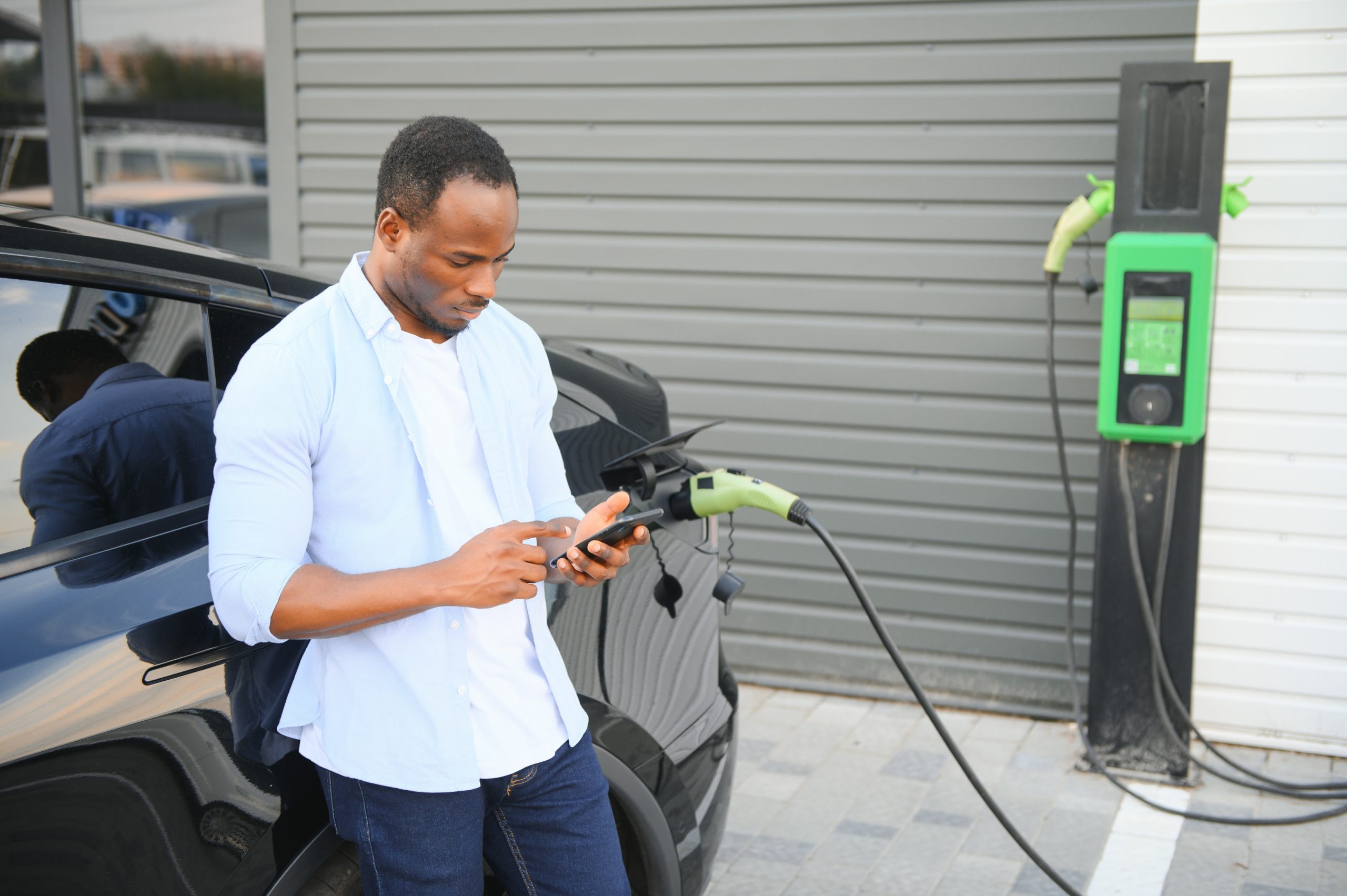
Thanks to more affordable vehicles and ongoing government support, electric vehicles (EVs) are seeing increasing adoption in emerging economies. As markets mature, the race is on to decide which countries and brands will come out on top.
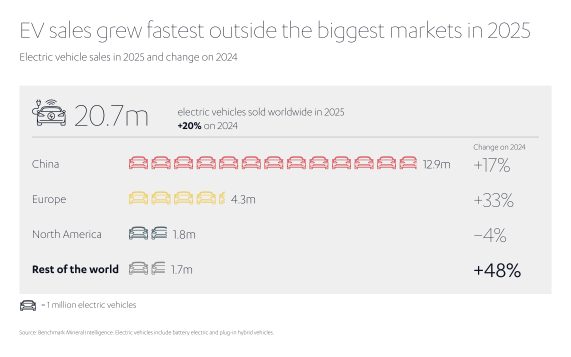
The global market for EVs is continuing to expand. But beneath the headline figures, a new picture is rapidly coming into view, with sales slowing in some of the largest EV markets, and explosive growth in many countries that were until recently minor players.
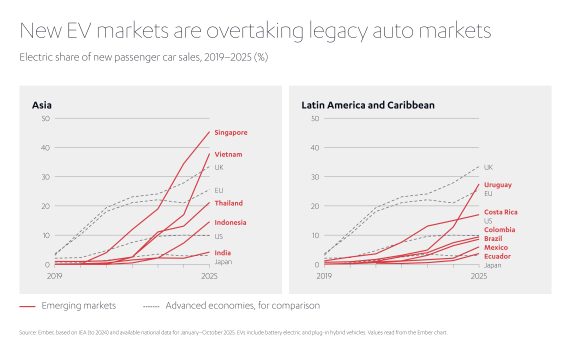
BloombergNEF expects more than a quarter (27%) of cars sold worldwide in 2026 to be electric, compared to 9% five years ago.[1] Three regions – China, Europe and North America – continue to see the lion’s share of EV sales, accounting for more than 90% in 2025[2], but the market is quickly diversifying. In 2019, there were four countries with an EV sales share above 10%, all within Europe. By 2025, 39 countries, 12 of them outside the continent, had reached the same benchmark.[3] Ember Energy believes we are in the midst of a radical transformation, with EV markets in emerging regions including Southeast Asia and Latin America ‘leapfrogging’ advanced economies such as the US and Japan.
The change has been particularly striking in Southeast Asia, where electric car sales more than doubled in 2025[4] to reach over half a million, accounting for about one in five cars sold across the region. According to the latest data from the International Energy Agency (IEA), countries seeing substantial growth in electric car sales include:
- Vietnam, where sales doubled in 2025 to reach almost 40% of new car sales, higher than in most European countries
- Thailand, where sales increased by 70% in 2025
- The Philippines, where the proportion shot up to 10% of new car sales in 2025, from a “negligible level” the previous year[5]
Similarly, Latin America saw growth of 75% in electric car sales in 2025 to reach more than 350,000, including:
- The tripling of sales in Mexico, with sales of plug-in hybrid electric cars increasing sevenfold
- 180,000 sales in Brazil – representing 9% of all new car sales, compared to 6.5% the previous year
- Uruguay’s sales rate doubling to reach nearly 30% of total new car sales[6]
Other countries seeing rapid growth in EV adoption include:
- Nepal, where EVs accounted for more than three quarters (76%) of new car sales in 2024[7]
- Türkiye, where one fifth of new cars sold in 2025 were electric, making the country Europe’s fourth-largest electric car market[8]
- Ethiopia, which has 115,000 EVs in operation – 8% of the country’s fleet[9]
Meanwhile, EV adoption in some of the largest markets is slowing. In the US, for example, data from BloombergNEF predicts a fall in EV sales to 19% in 2026, while monthly EV sales are also declining in China[10].
“This is a major turning point…. Emerging markets are no longer catching up, they are leading the shift to electric mobility.”
Euan Graham, Electricity and Data Analyst, Ember[11]
What are the challenges for EV adoption in emerging markets?
The traditional barriers for EV adoption in emerging markets can be grouped into four related areas:
Cost
Despite often having lower running costs, historically EVs have been more expensive to buy than their internal combustion engine (ICE) equivalents. Although the gap has narrowed, this perception persists. So, the findings of a 2023 European Commission survey that being too expensive was the biggest perceived disadvantage of battery electric vehicles (BEVs) is relevant to other parts of the world, too.
Convenience
EVs require a strong supporting infrastructure, most obviously, charging points, for which there is an ongoing need even in many relatively mature EV markets, such as the US. A recent study found that deploying charging infrastructure would be “essential for the widespread adoption of electric vehicles in India.”[12]
Confidence
Suboptimal infrastructureand high upfront prices combine with other issues to feed ongoing consumer hesitation about EVs. Research by EY in 2025 found that globally, EV demand was influenced by concerns such as range anxiety (29%) and high battery replacement costs (28%), as well as a lack of charging infrastructure (28%).[13]
Capacity
In markets across the world,the barriers to EV adoption share similarities, but overcoming them is harder in countries with lower incomes, fewer resources and weaker institutions. A 2025 study of the situation in Cambodia, Myanmar and the Philippines, for example, highlighted technological, policy, and social factors alongside economic and infrastructural challenges, including “fragmented governance” and “cultural skepticism”.[14]
Why are EVs now gaining ground in emerging markets?
In recent years, changing conditions have helped to significantly accelerate EV adoption in emerging markets.
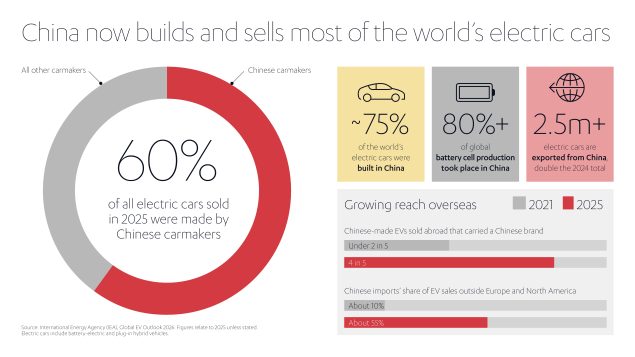
Falling costs: This is perhaps the biggest factor. Thanks to lower battery costs and manufacturing overcapacity, electric cars in China recently became more affordable on average than those with combustion engines[15]. In 2025, 70% of BEVs sold in the country were cheaper than their ICE equivalent, an increase from about 50% in 2021.[16]
This isn’t just good news for Chinese drivers. The export of affordable Chinese models is driving rapid adoption in many countries, accounting for 60% of sales in emerging markets outside China in 2025.[17] In Thailand, for instance, 88% of all EVs sold in 2025 were from Chinese companies[18]. Some analysts believe that high oil prices are accelerating this trend, making EVs even more attractive in comparison to petrol and diesel options.
Supportive policies: In addition to economic factors, many countries have intentionally designed policies to encourage EV adoption, including:
- A scheme of subsidies and tax breaks in Thailand[19]
- Registration fee exemptions in Vietnam[20]
- Exemptions from import duty and excise tax in Uruguay[21]
- Similar tax incentives in Nepal[22]
- A ban on the import of ICE vehicles in Ethiopia[23]
As well as sustainability, these policies are also driven by concerns over other issues such as air quality and energy security. Nepal, Uruguay and Ethiopia, for example, all have plentiful renewable electricity supplies, while importing fuel is expensive.
Domestic production: Not all emerging markets rely on Chinese imports to expand EV adoption. In Vietnam, for example, 98% of EV sales in 2025 were from domestic automaker VinFast, which is now estimated to hold more than a third of the country’s entire passenger car market[24].
In addition, in some countries Chinese automakers are setting up plants, or partnering with other companies, to manufacture EVs locally. In 2025, the proportion of electric cars sold in Brazil that were made in China was smaller than in 2024 – at about 85%. The IEA attributes this partly to the opening of a plant by Chinese brand Great Wall Motors, which produced almost 5% of the electric cars sold in the country.[25]
How is EV adoption happening in different emerging markets?
The path to EV adoption varies widely in different places. Let’s look at two very different markets to highlight the variety of possible approaches.
Vietnam: domestic dominance
Virtually non-existent in 2020, Vietnam’s electric car market has grown rapidly to become the largest in South East Asia[26]. This trend is supported by government policies aimed at tackling air pollution and greenhouse gas emissions. Electric cars are exempt from registration tax and reduced special consumption tax. This reduces costs considerably compared to ICE cars, which typically, for instance, pay a registration fee of 10%-15% of the vehicle price. Meanwhile, plans for low-emission zones in Hanoi and Ho Chi Minh City are encouraging the adoption of electric 2Ws.
The electric car market consists almost entirely of one domestic company, Vinfast, whose dominance is supported by its proprietary network of 150,000 V-Green charging points, accessible only to its own vehicles. In addition, being part of the large private Vingroup conglomerate has allowed the company to run substantial losses: it has not turned a profit since its 2017 founding[27].
Brazil: China’s largest car importer
Brazil is Latin America’s largest EV market – and it’s growing fast. According to the Brazilian Electric Vehicle Association (BEVA), 223,896 light electrified vehicles were sold in 2025, a 26% rise on the previous year[28]. In the first seven months of 2026, sales were already 21% higher than the 2025 total, at 271,091, and were expected to exceed 400,000 by the end of the year. This growth is mainly coming from Chinese imports. Between January and May 2026, the country became China’s largest car importer, purchasing US$ 5.2 billion worth of vehicles – of which US$ 4.5 billion were electric.
In focus: the Dolphin Mini
In February, the Dolphin Mini model from Chinese maker BYD became Brazil’s best-selling vehicle among private buyers – the first time this category was topped by an EV or Chinese brand. Across the whole Brazilian market, it was the seventh best-selling vehicle in the first eight months of 2026, with sales up 162% year on year.
Reduced import tariffs on electric and hybrid vehicles have been in place in Brazil since 2015, helping to drive adoption, but as EVs become more established in the country, these have been gradually reintroduced. Unusually, more plug-in hybrid EVs than BEVs are sold in Brazil. This is thought to reflect the lack of charging infrastructure outside of major cities, with consumers still preferring to have a combustion engine option. The charging network is growing fast, however. In May 2026, the number of charge points surpassed 25,000 – an increase of more than 20% in just three months.[29]
“Interest among Brazilians is high, including among the middle and upper-middle classes. Electric cars have become an object of consumer desire, and electric cars have become synonymous with Chinese cars.”
Tulio Cariello, director of content and research, Brazil-China Business Council[30]
What are the latest developments for the EV sector in emerging markets?
Across emerging markets, the EV sector is maturing. Manufacturers are eyeing future opportunities, and governments are exploring more nuanced policies as they seek to balance conflicting interests. Recent developments include:
- Support for domestic production
In many countries, Chinese exporters have benefited from generous policy incentives designed to encourage EV uptake. With markets now established, governments are putting an increased focus on supporting domestic production. In Indonesia, for example, the government ended existing nationwide tax incentives for EVs in April 2026, handing responsibility to regional governments. Meanwhile, the central government is planning new EV incentives which aim to support a “national electric-motorcycle ecosystem”, and the mass production of electric cars.
“Electric motorcycle subsidies and probably later electric cars will create markets for the national industry.”
Prabowo Subianto, Indonesian president[31]
2. Chinese brands establish physical bases
In response to less attractive import policies, Chinese manufacturers are establishing physical bases in emerging markets. In Brazil, as tariffs are phased back in, at least eight Chinese auto brands have now either begun or announced an intention to begin operations in the country[32] either through their own factories, or partnering with other brands to use existing facilities. BYD, for instance, says it has made 100,000 electrified vehicles at its plant in Camaçari since October 2025, and now directly employs 5,500 people there. Another Chinese brand (and Jameel Motors partner), Geely, acquired a 26.4% stake in Renault do Brasil last year, gaining access to Renault’s factory in São José dos Pinhais.
“Our continued cooperation with Renault in exploring new markets and new opportunities will make for a win-win scenario as both Renault and Geely are able to leverage technology scales on a global level to bring the best products to market.”
Eric Li, Chairman, Geely Holding Group
3. Western brands target luxury buyers
In September 2026, US EV maker Tesla registered a local company in Vietnam. While the business made no announcement, the move was seen as heralding a potential expansion into the country (although the reported starting capital of around US$ 3 million suggests a planned sales operation rather than a manufacturing base[33]).
This follows Tesla’s entry into the Indian market in September 2025. The company’s sales there have been modest to date but are rising fast. Though Tesla has abandoned plans for a factory in India[34], it has overtaken Mercedes to become India’s second-biggest seller of luxury passenger EVs, with 30% of the market, behind the leader, BMW. Overall, however, these brands’ proportion of the Indian market is tiny, with Tesla holding just 0.8%[35]. Their focus on affluent buyers highlights the challenge of competing with Chinese or domestic brands on price.
“It would be difficult for Tesla to compete with VinFast in Vietnam because VinFast has advantages that go well beyond product availability”.
Koketso Tsoai, senior automobiles analyst at BMI[36]
What does the future hold for EV brands?
The continuing growth of the EV sector, and the ambitions of diverse brands within it, looks set to have major consequences both in emerging and advanced economies. In the coming years, we can expect developments to include:
Policy differences
The expansion of Chinese EV manufacturing into Brazil has led to tensions between these firms, the government and carmakers already operating there. Last year, the Brazilian Association of Motor Vehicle Manufacturers (Anfavea) opposed the reduction of import taxes, which Chinese firm BYD had lobbied for ahead of opening its Camaçari factory. As a compromise, the government introduced a quota that meant eligible imports received temporary tax relief. The dispute was reignited this year when the quota was extended, with Anfavea threatening legal action. The expansion of the Chinese EV industry could lead to similar disagreements in countries such as Indonesia (where BYD opened a factory in 2026).
Partnerships and regional hubs
Facing intense competition, a number of Western EV makers are seeking to develop their market presence through arrangements with Chinese brands. Renault and Geely’s partnership in Brazil will allow the former to launch a new Renault vehicle from 2027, using Geely’s EV architecture[37]. Also in Brazil, in 2025 General Motors began producing the Chevrolet Spark EUV, an electric SUV designed by its China-based joint venture SAIC-GM-Wuling, based on one of its existing models. The concentration of EV manufacturing capacity in Brazil means it is becoming a production hub for the wider region: in March, BYD announced 100,000 orders for Argentina and Mexico[38]. In future years, we may see other countries follow a similar path.
Global challengers
European and US auto makers are also facing competition at home, as Chinese and other low-cost EV brands target their markets. In July 2026, Vietnam’s VinFast exported more
In focus: VinFast’s affordable EV revolution
VinFast has achieved mass-market popularity in Vietnam through small, budget-friendly models. The four-seat VF3, a mini-SUV just 3.2m long, was its best-selling car in 2025. A customization competition in 2025 encouraged people to personalize their VF3s, driving visibility and emotional attachment for the brand.
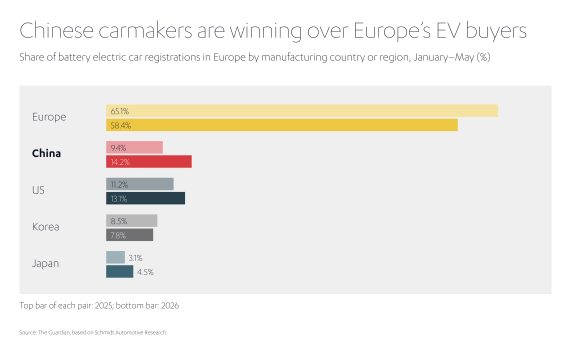
than 5,000 EVs, with around 1,500 destined for Europe. The company has pledged a long-term commitment to the continent, with its strategy involving electric buses and a network of local dealers and support services, as well as passenger cars specifically built for local needs. VinFast also has big ambitions in the US, although the EV market there is currently under performing, with high tariffs, stringent regulations and political opposition creating major barriers[39]. It’s a different story in Europe, where VinFast sales have risen to reach a record 14% market share in the first five months of 2026, despite stringent EU tariffs.
“This is more than an expansion of our network. It is a long-term commitment by VinFast to the U.S. market as we enter our next chapter of growth.”
Brian Finnerty, CEO, VinFast North America[40]
How popular are electric two- and three-wheel vehicles?
While many early EV incentive policies focused on cars, emerging economies are increasingly turning their attention to smaller vehicles such as motorcycles, scooters, and auto-rickshaws.
This approach has the potential to make EVs accessible to a wider section of the population, as two- and three-wheel vehicles (2/3Ws) offer considerably lower entry costs. In fact 2/3Ws are the leading vehicle type globally for electrification, with a 46% market share.[41] Worldwide sales of electric 2/3Ws reached 11 million in 2025, an increase of 15%.[42]
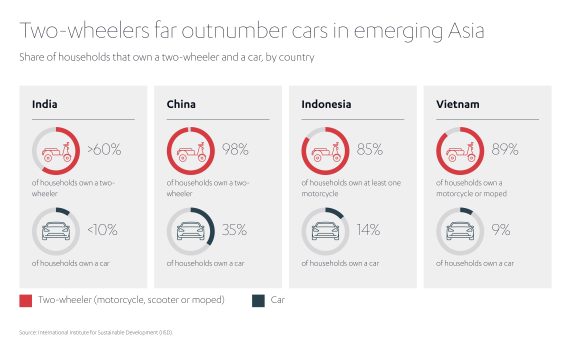
In Vietnam, industry competition involving both local companies and Chinese brands has involved offers such as discounts and trade-in programs, helping electric 2W sales more than double in 2025 to about 735,000.[43] In India, where Greaves Electric Mobility, (invested in by Abdul Latif Jameel in 2022) is a major player, less than 10% of households own a car, while more than 60% own a two-wheeler.
The Indian government’s current EV scheme excludes cars but provides continuing subsidy for 2/3W EV purchases, a policy which helped sales of electric 2Ws grow by 89% in the year to September 2026[44], while electric 3Ws now have a 70% share of the country’s 3W market.[45]
How is Jameel Motors helping to accelerate EV adoption in emerging markets?
Jameel Motors – the international mobility brand within the Abdul Latif Jameel network of diversified businesses – has operations in more than 10 countries across the Middle East, Africa, Europe, Asia and Australia.
Africa is a growing focus. In Morocco, for example, Jameel Motors is the national distributor for MG Motor, whose range includes EVs and plug-in hybrids. Similarly in Egypt, Jameel Motors has distributed GAC vehicles since 2023. Alongside this, Jameel Finance Egypt operates a dedicated financing program that enables buyers spread the cost of an EV over up to five years.
Elsewhere on the continent, in 2025 Jameel Motors entered South Africa, Africa’s largest vehicle market, where it distributes Changan Automobile’s range, including the all-electric Deepal S07 SUV and Hunter pickups.
Beyond Africa, Jameel Motors has built partnerships with a number of the Chinese brands that are reshaping the global EV market, including BYD, Geely, GAC, Changan, SAIC’s MG Motor and OMODA-JAECOO. These include markets from Türkiye and the UAE to Poland, Italy, the UK, Australia and Iraq.
The growing presence in these diverse markets is part of a wider commitment to the global EV transition. Whether the next wave of growth comes on two wheels, three wheels or four, from domestic champions or Chinese exporters, we’re committed to making cleaner mobility more affordable and more accessible for all consumers.
Five fast facts: the EV boom in emerging markets
Q: How fast are EVs growing in emerging markets?
A: Faster than in many advanced economies. In 2019, only four countries – all in Europe – had an EV sales share above 10%. By 2025, 39 countries had passed that mark, 12 of them outside Europe.
Q: Where is growth strongest?
A: Southeast Asia and Latin America are seeing particularly fast growth. Electric car sales more than doubled in Southeast Asia in 2025 and rose 75% in Latin America. Vietnam is one striking example. EVs made up almost 40% of its new car sales in 2025 – higher than in most European countries. Uruguay was close behind at nearly 30%.
Q: What’s driving the shift?
A: Above all, cheaper cars. In 2025, 70% of battery electric cars sold in China cost less than their combustion-engine equivalents, and affordable Chinese exports made up 60% of EV sales in emerging markets outside China.
Q: Is China winning the race?
A: Not everywhere. In Vietnam, 98% of electric car sales came from domestic brand VinFast. In Türkiye, home-grown Togg undercut Chinese rivals on price to win a 20% share of the BEV market. But Chinese brands are putting down roots: at least eight have begun or announced local operations in Brazil, which became China’s biggest car importer this year.
Q: Is it all about cars?
A: Far from it. Electric two- and three-wheelers offer a cheaper route to electrification, with 11 million sold worldwide in 2025. In India, fewer than 10% of households own a car, but more than 60% own a two-wheeler, helping to drive an 89% increase in sales of electric two-wheelers from January to September 2026.
[1] https://about.bnef.com/insights/clean-transport/bloombergnefs-electric-vehicle-outlook-2026-global-ev-sales-set-for-another-record-breaking-year-but-growth-in-some-major-markets-slows/
[2] https://source.benchmarkminerals.com/article/global-ev-sales-reach-20-7-million-units-in-2025-growing-by-20
[3] https://ember-energy.org/latest-insights/the-ev-leapfrog-how-emerging-markets-are-driving-a-global-ev-boom/
[4] https://www.iea.org/reports/global-ev-outlook-2026/trends-in-electric-cars#abstract
[5] https://www.iea.org/reports/global-ev-outlook-2026/trends-in-electric-cars#abstract
[6] https://www.iea.org/reports/global-ev-outlook-2026/trends-in-electric-cars#abstract
[7] https://ember-energy.org/latest-insights/the-ev-leapfrog-how-emerging-markets-are-driving-a-global-ev-boom/
[8] https://www.iea.org/reports/global-ev-outlook-2026/trends-in-electric-cars#abstract
[9] https://yaleclimateconnections.org/2026/05/fuel-shortages-and-high-prices-push-adoption-of-evs-in-africa-led-by-ethiopia/
[10] https://www.scmp.com/business/china-business/article/3363737/chinas-ev-sales-slide-again-amid-fading-incentives-weak-demand-and-persistent-price-war
[11] https://ember-energy.org/latest-insights/the-ev-leapfrog-how-emerging-markets-are-driving-a-global-ev-boom/
[12] https://www.tandfonline.com/doi/full/10.1080/23311916.2026.2684093#d1e2461
[13] https://www.ey.com/en_gl/newsroom/2025/12/global-consumers-driven-back-to-ice-vehicles-as-ev-enthusiasm-cools-ey-research
[14] https://link.springer.com/article/10.1007/s43621-025-01637-4
[15] https://www.statista.com/chart/amp/34890/average-list-price-of-battery-electric-vehicles-and-combustion-engine-cars/
[16] https://www.iea.org/reports/global-ev-outlook-2026/trends-in-electric-cars
[17] https://www.iea.org/reports/global-ev-outlook-2026/trends-in-electric-cars
[18] https://about.bnef.com/insights/clean-transport/bloombergnefs-electric-vehicle-outlook-2026-global-ev-sales-set-for-another-record-breaking-year-but-growth-in-some-major-markets-slows/
[19] https://www.boi.go.th/upload/content/EV%203.5ENG.pdf
[20] https://www.reuters.com/legal/transactional/vietnam-plans-extend-tax-incentives-evs-until-2030-2026-04-20/
[21] https://www.mobilityportal.eu/en/notes/uruguay-analiza-quita-de-subsidios-a-vehiculos-electricos-ante-un-mercado-maduro-la-alarma-del-sector
[22] https://www.fastcompany.com/91345333/how-nepal-became-one-of-the-worlds-fastest-growing-ev-markets?utm_source=firefox-newtab-en-gb
[23] https://www.theguardian.com/global-development/2025/sep/12/ethiopia-electric-vehicle-power-petrol-diesel-cars-dam-green-energy
[24] https://www.cnbc.com/2026/09/22/tesla-vinfast-ev-vietnam.html
[25] https://www.iea.org/reports/global-ev-outlook-2026/trends-in-electric-cars
[26] https://en.vietnamplus.vn/vietnam-becomes-southeast-asias-largest-ev-market-as-sales-surge-post352221.vnp
[27] https://www.reuters.com/world/asia-pacific/vietnamese-ev-maker-vinfasts-move-shift-7-billion-debt-raises-red-flags-2026-05-21/
[28] https://latamobility.com/en/abve-brazil-2025-electromobility-record-market/
[29] https://latamobility.com/en/brazil-surpasses-25000-charging-points-for-electric-vehicles-and-shows-21-growth-in-just-three-months/
[30] https://valorinternational.globo.com/business/news/2026/07/28/brazil-becomes-worlds-top-importer-of-chinese-cars.ghtml
[31] https://www.scmp.com/week-asia/economics/article/3364338/can-indonesia-build-rising-ev-demand-become-production-powerhouse
[32] https://valorinternational.globo.com/business/news/2026/06/26/eight-chinese-automakers-commit-to-manufacturing-in-brazil.ghtml
[33] https://finance.yahoo.com/markets/stocks/articles/tesla-enters-vietnam-3-million-133427557.html
[34] https://finance.yahoo.com/sectors/technology/articles/tesla-scraps-india-factory-years-204000463.html
[35] https://www.autocarpro.in/analysis/exclusive-tesla-sales-in-india-cross-1000-units-550-model-ys-delivered-since-july-135037
[36] https://www.cnbc.com/2026/09/22/tesla-vinfast-ev-vietnam.html
[37] https://www.renaultgroup.com/en/magazine/our-group-news/renault-geely-in-curitiba-the-partnership-becomes-an-industrial-reality/
[38] https://www.globalchinaev.com/post/byd-to-build-57-million-ev-testing-center-near-rio-de-janeiro-brazil
[39] https://www.cnbc.com/2026/06/06/chinese-evs-auto-sales-manufacturing-us.html
[40] https://vinfastauto.us/newsroom/press-release/vinfast-expands-dealership-network-reinforcing-long-term-commitment-to-the
[41] https://about.bnef.com/insights/clean-transport/electric-vehicle-outlook/#executive-summary-preview
[42] https://www.iea.org/reports/global-ev-outlook-2026/trends-in-other-ev-modes
[43] https://e.vnexpress.net/news/business/companies/electric-motorbike-makers-offer-discounts-as-vietnam-moves-away-from-gasoline-4920380.html
[44] https://auto.economictimes.indiatimes.com/news/two-wheelers/electric-two-wheeler-retail-sales-surge-89-to-2-07-lakh-units-in-september-fada/134763601
[45] https://www.iea.org/reports/global-ev-outlook-2026/trends-in-other-ev-modes


 Dubai, United Arab Emirates November 12 , 202619 minute read