

 Dubai, United Arab Emirates September 21 , 2026
 20 minute read
Why is energy infrastructure so critical for an EV future?
Dubai, United Arab Emirates July 7 , 202619 minute read
Electric vehicles (EVs) are moving from niche technology to mainstream transport infrastructure. But the future of electric mobility depends on far more than merely the vehicles themselves. It depends on whether countries can build the energy infrastructure – both generation and distribution – required to support them.
How fast is the EV market growing?
Global EV sales surpassed 17 million in 2025, according to the International Energy Agency (IEA), giving EVs more than 20% of total global vehicle sales for the first time[1]. By 2030, EVs are projected to account for around 40% of worldwide car sales, driven by rapid adoption across China, Europe, Southeast Asia and increasingly, North America[2].
What are the biggest challenges to EV adoption?
For many people, concerns around charging speed, battery range and charger availability still shape perceptions of EV ownership. Range anxiety has long been one of the biggest barriers to adoption, particularly for drivers accustomed to the convenience and speed of traditional internal combustion engine (ICE) vehicles. Public charging networks may be expanding, but questions remain over whether electricity grids, urban infrastructure and charging ecosystems can evolve quickly enough to meet increasing demand.
This challenge is transforming the global energy landscape. Governments, utilities, OEMs and private investors are now racing to develop smarter, faster and more resilient charging infrastructure capable of supporting a fully electrified transport future.
The transition is already reshaping how energy is generated, distributed and consumed. Ultra-fast charging networks are reducing recharge times from hours to minutes. Vehicle-to-grid (V2G) systems are enabling EVs to store and return electricity to national grids. AI is helping utilities balance demand in real time, while wireless charging and decentralized energy systems are redefining how and where vehicles recharge.
How fast is EV infrastructure developing?
With EV adoption rapidly accelerating, the number of public charge points is likewise expanding, rising to 5.5 million by 2025, a tenfold increase since 2018.[3]
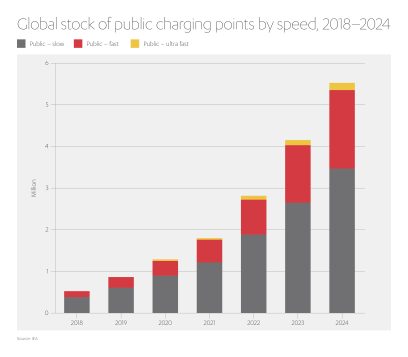
Yet this is just the start, with research suggesting that the world will need hundreds of millions more charging connectors by 2040 to keep pace with EV sales.[4]
Stopping mid-journey to recharge a low battery can be inconvenient, but much less so if you know a turbo-charged top-up awaits. New so-called ‘Level 3’ ultra-fast chargers (UFCs) such as the Tesla Supercharger are becoming a common sight in forecourts worldwide, delivering up to 150km of range in a little as 15 minutes.[5]
UFCs outperform traditional chargers because they deliver direct current (DC) straight to the battery, bypassing the car’s onboard converter. Temperatures are controlled by advanced battery thermal management systems, preventing overheating.
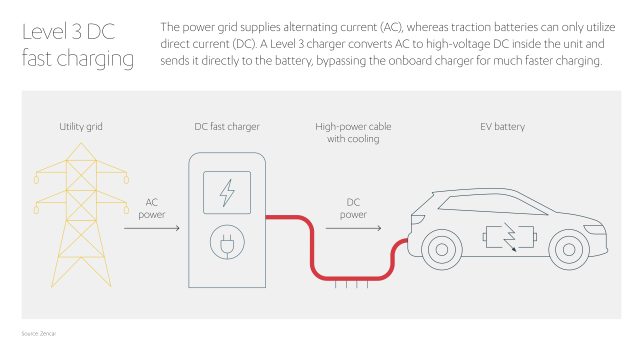
With unit prices falling by a fifth since 2002, the global stock of UFCs – those capable of delivering 150 kW or above – climbed 50% in 2024 and now comprise almost 10% of all fast chargers.[6] Chinais leading the way, its network of UFCs expanding from 1.2 million to 1.6 million in the space of a year, or 80% of total global growth.
However, extra speed comes with one drawback: A price that not everyone might be able to afford.
Fast conduction equipment places a strain on multi-point charging stations as well as the wider energy grid. BYD’s new Flash Chargers, for example, draw around 1.2 megawatts of power, more than 150 times typical home chargers.[7] Such dramatic spikes in electricity demand require extensive infrastructure upgrades, with costs passed along to customers. The result? High-power charging can be up to six times more expensive than home charging.
Ensuring the optimal distribution of varying types of chargers means adapting to a new approach to ‘refueling’. Drivers no longer stop to charge up. Instead, they charge up wherever they happen to stop.
How are EV charging habits changing?
Chargers need to be where people spend their time. For drivers of EVs, research shows mid-journey charging will account for only around 5% of demand.[8] Traditional notions of gas forecourts along highways are giving way to a plethora of charge points at homes, offices or car parks.
Take the USA, for example. Scenarios suggest some 33 million EVs on American roads by the end of the decade.[9] With up to 80% of vehicle charging currently carried out overnight, the vast majority of new chargers will be needed in homes. More than 26 million ports at domestic premises will together account for 52% of national charging investment. These home connections will be supported by a robust national network of public chargers, with more than a million ports at shops and workplaces (comprising 9% of national charging investment) and a further 180,000 fast-charging ports in key transport corridors (39% of investment).[10]
Frameworks for funding this vast new charging network are still taking shape. Commercial uncertainty, together with varying permission pathways in different regions and a lack of specialist labor is threatening to slow the charging revolution just as it should be amping up to full power.
The secret to a smart, decentralized energy system lies in managing costs while embedding sustainable infrastructure into urban planning.
Foresight is key. New developments, or applications for extensive remodeling, must be assessed through the lens of energy distribution. A supermarket introducing a bank of high-speed chargers, for example, can see its energy consumption rise by as much as 250% at peak times.[11] Planning for such investments requires consultation with stakeholders all along the value chain, from grid controllers to power plant coordinators and even raw material suppliers. In anticipation of present and future EV energy demands, building codes need adjusting to include compulsory charge points.
Infrastructure installation isn’t cheap, but several strategies can improve affordability, including:
- Government grants and subsidies to offset startup costs
- Public-private partnerships to help spread risk
- Establishing common standards between different developers and nations to reduce manufacture and fitting costs
Which new technologies could reshape charging infrastructure?
Smart charging – keeping costs low while reducing strain on the network – entails constant communication between EVs and the grid, supplemented by AI analytics and IoT technology:
- Fleet operators can use energy management systems to balance demand with variables such as grid load, renewable availability and weather
- Carefully managed ‘microgrids’ can mean more efficient power use, lowering carbon emissions and reducing expenses
- Time-of-use tariffs can encourage consumers to charge their vehicles during quiet periods, reducing grid demand during peak hours
Smart charging, according to one study, can save customers up to 70% of vehicle running expenses, perhaps making a crucial difference when families come to choose their next automobile.[12]
Until these ecosystem advances become commonplace, charging will continue to be an issue for many early adopters of EVs. In the USA, for instance, around 40 million drivers currently lack domestic charging facilities, pitching their sustainability principles in direct conflict with practicality.[13]
Innovators are keen to remedy such shortfalls, particularly in the USA. More than a hundred dedicated curb-side charge posts were installed across New York City in 2025. Los Angeles has embarked on a program of adapting streetlights for plug-in cables. Boston, meanwhile, is investigating another avenue entirely: building-powered chargers.
Building-powered chargers funnel energy from rooftop solar panels directly into vehicles parked outside. Most domestic building-powered chargers operate at 7.4kW, approximately eight times faster than conventional three-pin sockets. Dynamic load management systems keep charging rates safely within capacity limits, while integrated apps allow for off-peak charging. Building-powered chargers can be up to five times cheaper than public charging and can add several thousand dollars of value to a property.
With charging infrastructure still playing catch-up with buyer trends, another way to prepare ourselves for an electrified future is by extending the driving distances achievable by EVs.
How could extended range vehicles and wireless charging shake-up the market?
Larger battery capacities and lengthier driving distances are a make-or-break issue for almost half of potential EV motorists, cited as a priority by 42% of respondents to an EV global adoption survey.[14] The industry has listened, and responded with a new focus on range capacity.
Extended-range EVs (EREV or sometimes referred to as Range Extended EV (REEV)), featuring a small ICE-powered generator to recharge the battery pack during motion, are increasingly entering the market. EREVs, often charged using faster AC kit, offer driving ranges several times longer than ordinary plug-in hybrids, sometimes in excess of 200 miles on electric power alone.[15]
While maintaining a partial dependence on fossil fuels, EREVs make a dramatic difference to journeys. The Ram 1500 Ramcharger in the USA, for example, sports a 145-mile pure electric and 690-mile total driving range. In China, Aito’s new M9 logs a 170-mile electric range and a total distance of 871 miles, and Li Auto’s forthcoming Next Gen L9 records 134 all-electric miles and 817 total mileage.

The Changan Hunter K50 REEV launched in South Africa by Jameel Motors as the world’s first range-extended electric pickup (or ‘bakkie’ as they are known locally), is designed to bridge the gap between electric efficiency and long-distance requirements. It features dual electric motors, a 31.2 kWh battery, and a 2.0L petrol generator for a circa 1,000 km total range.
A survey of thousands of car buyers shows a significant share would contemplate an EREV as their next vehicle if the option was available.[16] Two-thirds of buyers were only purchasing ICE or hybrids in the absence of appropriate EREV alternatives, suggesting a wider rollout of EREVs could hasten our switch to a more electrified world.
How does wireless charging work?
Another complementary technology that could make owning an EV even more user-friendly is wireless charging, which replaces physical cables with high-frequency electromagnetic induction.
The two main types of wireless charging are:
- Static charging, which allows parked vehicles to recharge via an electrified pad fixed to the road surface
- Dynamic wireless charging, still at the trial stage, which involves specially adapted road surfaces recharging EVs as they drive along.
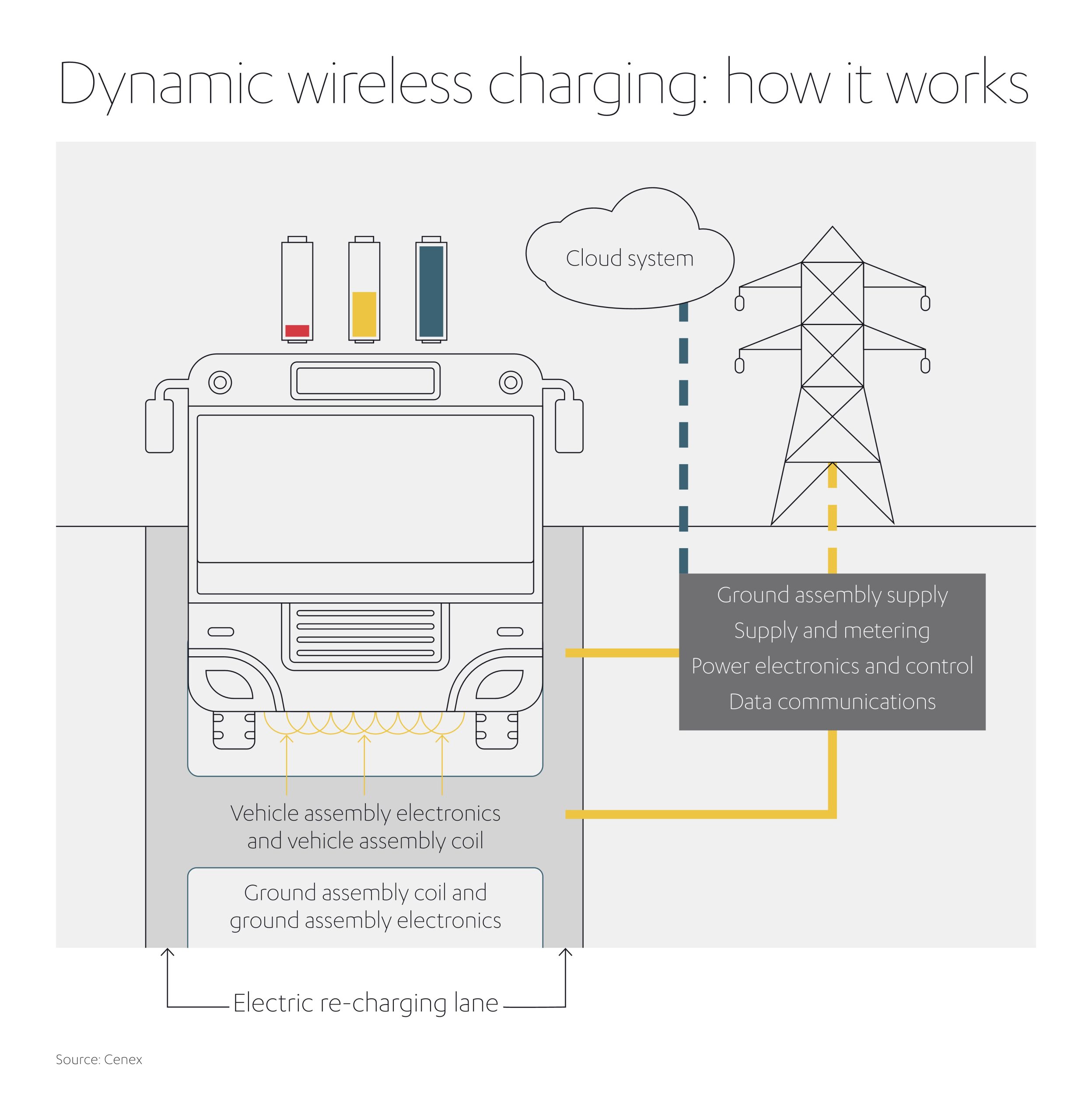
Technology firms are already demonstrating the first efficient wireless EV charging systems. Electreon, one of the world’s leading proponents of wireless charging, operates pilot schemes around the world. The company manages the USA’s first wireless charging road, a quarter mile stretch of 14th Street in Detroit with inductive coils embedded beneath the surface. Similarly, in California, Electreon is providing wireless charging for UCLA’s BruinBus shuttle fleet in advance of the 2028 Los Angeles Olympics, with dynamic coils planted under a key stretch of the traffic route.
International standards for wireless charging have already been established, with the SAE J2954 agreement ensuring interoperability for light‑duty static wireless charging – a guarantee which should boost investor confidence in the sector. Major auto marques are on board. Porsche is bringing 11 kW wireless charging to future EVs like the Cayenne, while Mercedes-Benz is testing wireless induction platforms with its experimental ELF concept. The wireless EV charging market, estimated to be worth some US$ 46.5 million in 2025, is forecast to reach US$ 3.37 billion over the coming decade with a CAGR of 53.5%.[1] Maximizing these returns will mean integrating EV charging systems with the very latest AI technologies.
Wireless charging goes global
The wireless charging revolution is global in nature. In Türkiye, tech firm Magneks has designed resonant inductive charging pads maintaining 94% to 98% efficiency between the AC grid and the battery.[1] In Singapore, Chargewerx Wireless offers subscription-based services for taxi fleets, with strategically placed charge pads at urban hotspots to help drivers reduce downtime and maximize productivity.[1] And in Germany, Seamless Energy Technologies is developing electric road systems to charge EVs using modular ‘coil carpets’, designed for fast and economic installation into road surfaces.
Can AI empower EV energy transformation?
The energy demands of a fully electrified transit system are likely to be highly uneven. Usage will vary according to time of day, season, roadworks and special events. How can we navigate these often unpredictable energy demands? And how can we ensure that grids avoid overload and manage any surplus energy wisely?
AI-driven grid management probably offers our best hope.
AI grid management transforms the electricity grid from a static, centrally-managed network into a real-time adaptive system.
A fully-integrated AI-led energy system would have access to sensors, smart meters and power plants across an entire city. It would combine big data and live feedback to continually predict supply and demand, optimizing power flows and balancing generation and storage. What might take hours or days of human planning, AI can accomplish in seconds with greater reliability.
Crucially for the climate crisis, AI-controlled grids can better integrate the varying inputs of renewable energy sources such as wind and solar. By measuring usage against capacity minute by minute, AI-driven grids reduce energy waste, potentially lowering prices for customers. With the ability to detect failing transformers before they break, and even reroute power during disruptions, AI grids can mean fewer blackouts, faster recovery times and greater resilience under stresses such as heatwaves.
Such analytical power will prove even more important as cities become more electrified and as EVs increase charging loads. A holistic AI system, hooked into every asset in a surrounding area, can automatically schedule charge times for parked vehicles to harmonize grid demand; it can even use distributed batteries to stabilize the grid during periods of excess production.
AI-driven load management remains at the pilot stage. Some in the energy sector are already testing bespoke software to process data, such as weather and traffic trends, to predict grid demand days in advance. Others are trialing AI’s ability to harness dispersed energy resources (everything from EV chargers to smart thermostats and home batteries) and balance energy dispersal during peak hours, protecting the grid. China, for example, is using DeepSeek’s open-source AI models to predict demand for natural gas. And in the USA, one AI platform is already managing the smooth integration of fluctuating renewable sources into the grid in California, causing a 20% upswing in the share of renewable energy used.
How AI could transform grid management
AI management devices are currently sold as advisory tools, rather than full control systems, meaning utilities may hesitate to trust them for critical decisions. However, as data accumulates and performance improves – and as aging infrastructure is gradually succeeded by modern, smart-equipped replacements – we will see more instances of large-scale, real-world deployment.
Duke Energy, a Fortune 500 American energy provider, is one of the businesses at the vanguard of AI-driven grid technology. It has developed a hybrid AI system blending machine learning with precision diagnostics to identify breakdowns before they happen, via a connected web of circuits spanning Duke’s transformer fleet.
Another US renewable energy supplier, Avangrid, has unveiled its ‘First Time Right Autopilot’ genAI tool, a chatbot which can draw on the company’s extensive internal manuals to answer engineers’ technical queries on the spot.
How does vehicle-to-grid technology work?
With the strategic input of AI, bi-directional vehicle-to-grid (V2G) technology could emerge as a useful tool for high-level grid management.
As more people adopt EVs, pressure increases on power systems. In a reversal of the normal process, V2G systems allow energy stored in a battery to flow back to the power grid from a car, based on localized data such as energy production and demand.
V2G requires both cutting-edge software and hardware to work. Advanced software platforms monitor multiple EVs simultaneously, measuring battery status and charging habits and balancing that data against current grid status. If intervention is needed then the hardware kicks in, a specialized bi-directional charger pushing energy back to the grid until equilibrium is restored.
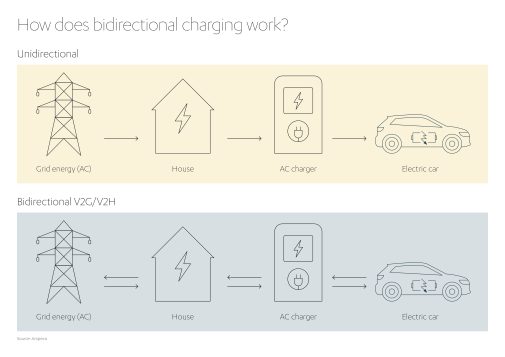
Instead of just consuming power, V2G-equipped EVs become part of a dynamic fleet of storage assets that can support the wider network. Many V2G projects worldwide are operating at the trial stage, often focusing on buses and delivery vans due to their predictable parking times and high energy capacity. As the technology matures from pilot projects to commercial deployment, V2G should help us orchestrate renewable energy demand and more efficiently balance our energy system.
To keep the sustainability dream alive, as electrical infrastructure expands we must ensure that the power we generate is as clean as possible, avoiding unnecessary greenhouse gases in our atmosphere.
Could ‘electric cities’ spark a greener future?
As our infrastructure is rebuilt around the principles of a smart, sustainable electrical world, we need to consider with greater care the sources of the energy upon which we depend. Charging EVs is a particularly energy-hungry activity, with a typical four-stall fast-charging station consuming as much energy as a 300-unit apartment building.[18]
To achieve net zero by 2050, annual renewable energy use must increase at an average annual rate of about 15% between now and 2030, a fourfold increase in growth rate over the past five years.[19]
Private sector companies such as Abdul Latif Jameel, active across the world in the green energy industry, are becoming critical players in the world’s transition to an electrified economy. Abdul Latif Jameel’s flagship renewable energy business, FRV, manages more than 3 GW of green energy presently in operation (rising to over 4 GW including projects in development and construction) across four continents.
In February 2026 it announced plans for a €2.8 billion data center in Merida, Spain. With €700 million to be invested directly in energy infrastructure – and with more than 80% of electricity coming from renewable self-generation – the Lusitanus data center will be one of the largest and most technically advanced industrial projects in Europe.
Summer 2025 saw FRV’s Masrik-1 55 MW PV plant, the largest in Armenia, commence operations. Energy from the facility will power more than 20,000 homes and avoid the emission of 54,000 tons of CO2 annually.
FRV has been especially active in Australia, where FRV Australia’s largest project to date, Walla Walla, became operational in October 2025. The same month, FRV Australia announced the development of the 450 hectare Rangitīkei solar farm in New Zealand’s North Island, supplying clean energy for 45,000 homes, and creating around 250 jobs during construction.
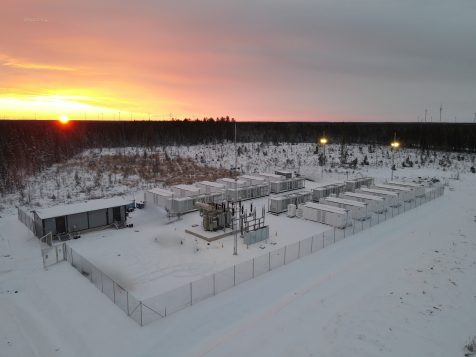
FRV is also a key player in Battery Energy Storage Systems, or ‘BESS’ projects. Sites in the UK include Holes Bay, Dorset; Contego, West Sussex; and Clay Tye, Essex. The company has also established a BESS Center of Excellence in Madrid, Spain, and is spearheading private sector efforts to promote BESS plants throughout Europe, Australia and Latin America.
When visualizing charge networks of the future, it is time to forget thoughts of simple plug-and-charge stations. Envisage instead an entire interlinked, intelligent energy ecosystem. This is a system in which all our devices – from EVs to smartphones and everything in between – freely exchange not just data but also energy as dictated by the needs of a clean, green power grid.
Imagine electricity not as a current but as a lifeblood, pumping energy around the many limbs and organs of the city – the districts, suburbs and factories – to keep it alive and vibrant. That is the sustainable vision we must nurture in our minds: An electrified city and, in time, an electrified world.
Five fast facts
Q: Are EVs likely to place greater strain on global energy grids in the coming years?
A: Yes – the IEA’s Global EV Outlook report of 2025 showed annual EV sales passing 17 million globally, winning a sales share of more than 20% for the first time.
Q: Is the public charge network expanding rapidly?
A: The number of public charge points globally has soared tenfold from 2018, to some 5.5 million units now.
Q: Are recharge speeds driving innovation?
A: The number of ultra-fast chargers – those capable of delivering 150 kW or above – grew by 50% in 2024 and now comprise around 10% of all fast chargers.
Q: Where should new charger capacity be targeted?
A: Up to 80% of EVs are currently charged overnight, indicating that the vast majority of new chargers will be needed in domestic homes.
Q: Could more sophisticated electrical infrastructure hasten the adoption of electric vehicles?
A: Almost certainly. Battery capacity and range anxiety is cited as a deterrent by 42% of potential EV buyers.
[1] https://www.iea.org/reports/global-ev-outlook-2025/executive-summary
[2] https://www.iea.org/reports/global-ev-outlook-2025/executive-summary
[3] https://www.iea.org/reports/global-ev-outlook-2025/electric-vehicle-charging
[4] https://www.ft.com/partnercontent/schneider-electric/driving-forward-how-the-world-must-adapt-for-the-electric-vehicle-transition.html
[5] https://www.iea.org/reports/global-ev-outlook-2025/electric-vehicle-charging
[6] https://www.iea.org/reports/global-ev-outlook-2025/electric-vehicle-charging
[7] https://rmi.org/ev-charging-the-importance-of-affordable-convenient-access
[8] https://www.ft.com/partnercontent/schneider-electric/driving-forward-how-the-world-must-adapt-for-the-electric-vehicle-transition.html
[9] https://rmi.org/ev-charging-the-importance-of-affordable-convenient-access
[10] https://docs.nrel.gov/docs/fy23osti/85654.pdf
[11] https://www.ft.com/partnercontent/schneider-electric/driving-forward-how-the-world-must-adapt-for-the-electric-vehicle-transition.html
[12] https://www.ft.com/partnercontent/schneider-electric/driving-forward-how-the-world-must-adapt-for-the-electric-vehicle-transition.html
[13] https://www.mckinsey.com/features/mckinsey-center-for-future-mobility/our-insights/drivers-of-disruption/powering-cities-at-the-curb-its-electric-and-the-future-of-urban-ev-charging
[14] https://www.mckinsey.com/features/mckinsey-center-for-future-mobility/our-insights/exploring-consumer-sentiment-on-electric-vehicle-charging
[15] https://www.mckinsey.com/featured-insights/mckinsey-explainers/what-is-an-erev
[16] https://www.mckinsey.com/featured-insights/mckinsey-explainers/what-is-an-erev
[17] https://www.futuremarketinsights.com/reports/wireless-ev-charging-market
[18] https://www.mckinsey.com/features/mckinsey-center-for-future-mobility/our-insights/drivers-of-disruption/powering-cities-at-the-curb-its-electric-and-the-future-of-urban-ev-charging



 Dubai, United Arab Emirates May 29 , 202619 minute read