What’s the real cost of traffic congestion?
 Dubai, United Arab Emirates October 8 , 2026
 20 minute read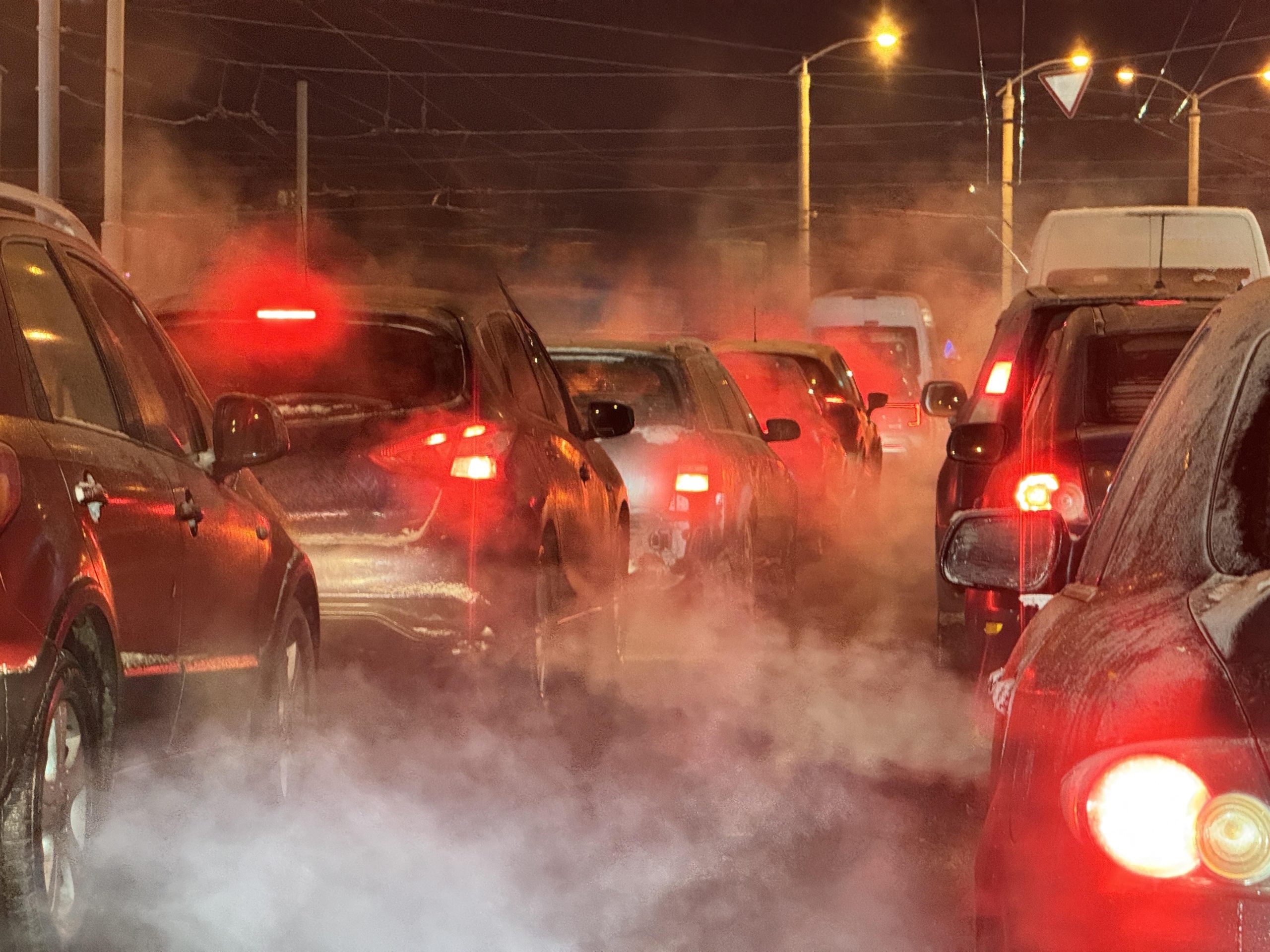
Traffic congestion hurts economies, health and the environment – and it’s getting worse. What can cities and businesses do to tackle the problem?
Traffic congestion is a growing problem globally – and its effects are far-reaching. From economic losses to impacts on the environment, health and communities, it’s an issue that leads to a lot more than frustration. With vehicle ownership continuing to grow, failing to address congestion will only make it worse. But by taking action through targeted regulation, imaginative design, strategic investment and green technology, there’s real potential not only to manage congestion effectively, but to make cities better places to live and work.
Is congestion increasing?
Traffic congestion across the globe continues to increase. In INRIX’s most recent annual study on the issue in 2025, 62% of the urban areas it analyzed saw a growth in traffic delays, compared to 55% the year before. The broad areas seeing an overall rise included the US and Asia, as well as Italy and Germany.
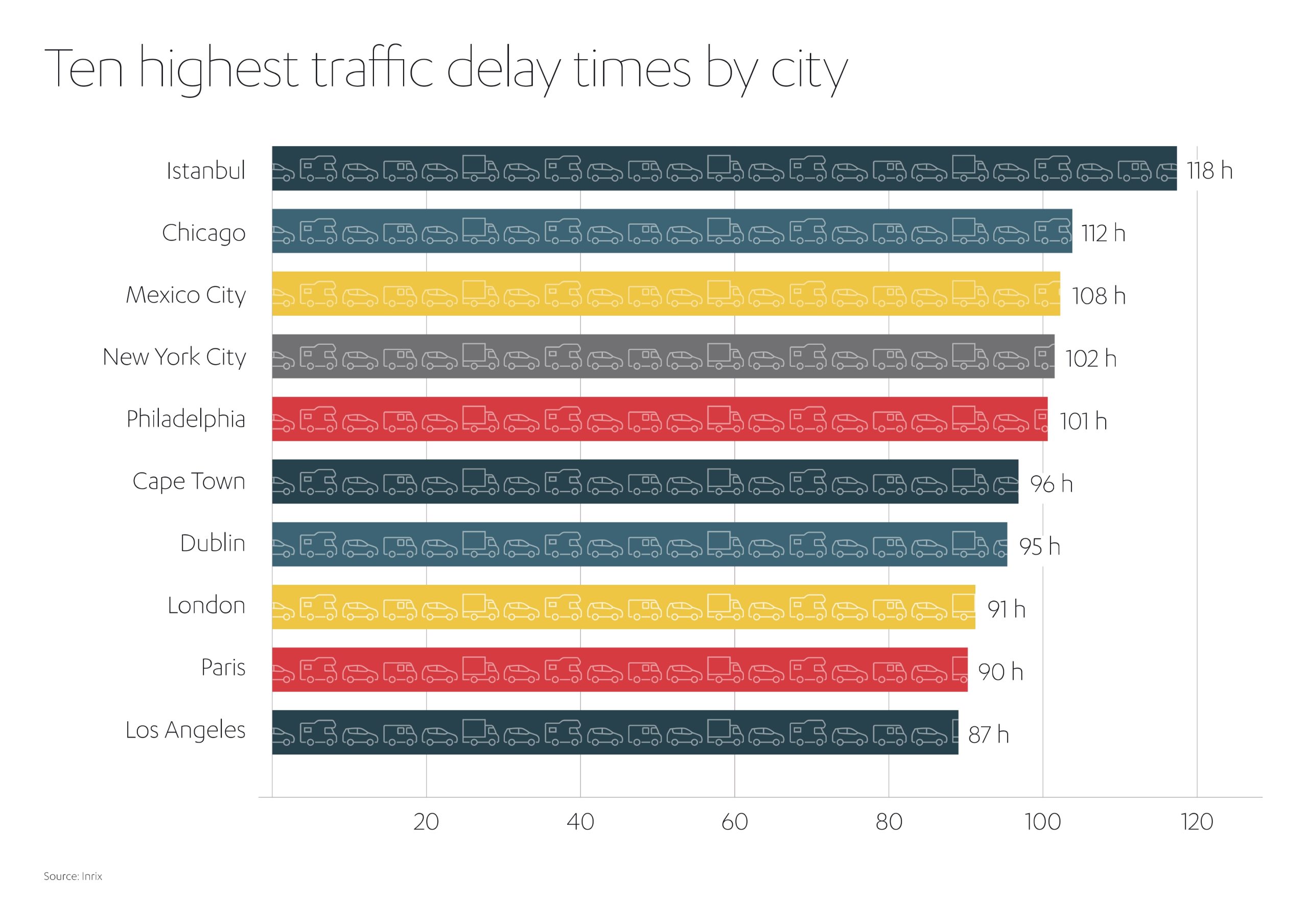
- Overall, Istanbul was the city with the most delays – losing 118 hours – followed by Chicago and Mexico City (112 and 108 hours lost respectively).
- All of the top three saw an increase in delays of 10% or higher, with 20 other of the top 100 areas also seeing double-digit growth.[1]
Similar findings emerged from TomTom’s annual traffic index, which found that global congestion rose from 20% to 25% in 2025.
- The most congested city in the TomTom rankings was Mexico City, with an average congestion level (representing the additional time a trip takes due to traffic) of 75.9%.
- Bengaluru in India (74.4%), and the Irish capital Dublin (72.9%), were in second and third place.
- Colombia was the most congested country, with a score of 48.8%, with Malta (45.1%) and the Philippines (44.6%) close behind.[2]
According to Ralf-Peter Schäfer, TomTom’s vice president for traffic and travel information, the increase in congestion calls for “urgent action to address the multifaceted challenges” behind it. Planners and policymakers, he said, need a better understanding of mobility, transport and traffic management issues to make decisions that “ensure cities remain livable, efficient, and sustainable in the face of growing congestion.”[3]
Why is congestion rising?
There are many overlapping reasons why traffic congestion is getting worse, with some of the most significant being growing urban populations, rising car ownership and the increasing prevalence of e-commerce. Let’s take a closer look:
Growing populations
At its root, congestion comes down to supply and demand. More people means more vehicles and more traffic, leading to more pressure on road space and more delays. Almost half (45%) of the global population lives in cities – more than double the proportion in 1950 – and the number of ‘megacities’ with more than 10 million people has quadrupled since 1975 to reach 33 in 2025. Between now and 2050, two thirds of global population growth is expected to occur in cities.[4]
Aside from pure numbers of people, urban sprawl can in itself drive congestion, because people living further from the center need to travel longer distances for work and other activities. Some also argue that high housing costs are contributing to this issue, with residents living further from work for affordability reasons.[5]
Urban sprawl can in itself drive congestion, because people living further from the center need to travel longer distances for work and other activities
The creation of additional road space is not keeping pace with this demand. In Asia, road construction grew at 2.5% a year between 2010 and 2014, far slower than the 7.3% annual increase in vehicle ownership[6]. And in any case, simply providing more road capacity is not necessarily an effective long-term answer. A number of studies have backed up the concept of induced demand, where road expansion encourages higher use, meaning that in time, congestion returns.[7],[8]
Increasing car ownership
The use of cars and other road vehicles continues to rise. The US, for instance, has seen a steady increase in the number of total registered vehicles for decades, reaching 284 million in 2023[9]. In 2026, Ipsos found that driving was the single favorite mode of transport in 22 of 31 countries it surveyed[10], and the global passenger car market is projected to grow annually to 2030.[11]
An increase in the use of private cars and motorbikes is particularly strong in developing countries.[12] In Colombia, there were more than 100,000 new vehicles registered between January and April 2026, a 49.3% rise from the same period the previous year.[13] While in Africa, vehicle kilometers travelled (VKT) by private passenger vehicles is expected to more than double between 2015 and 2030.[14]
More delivery vehicles
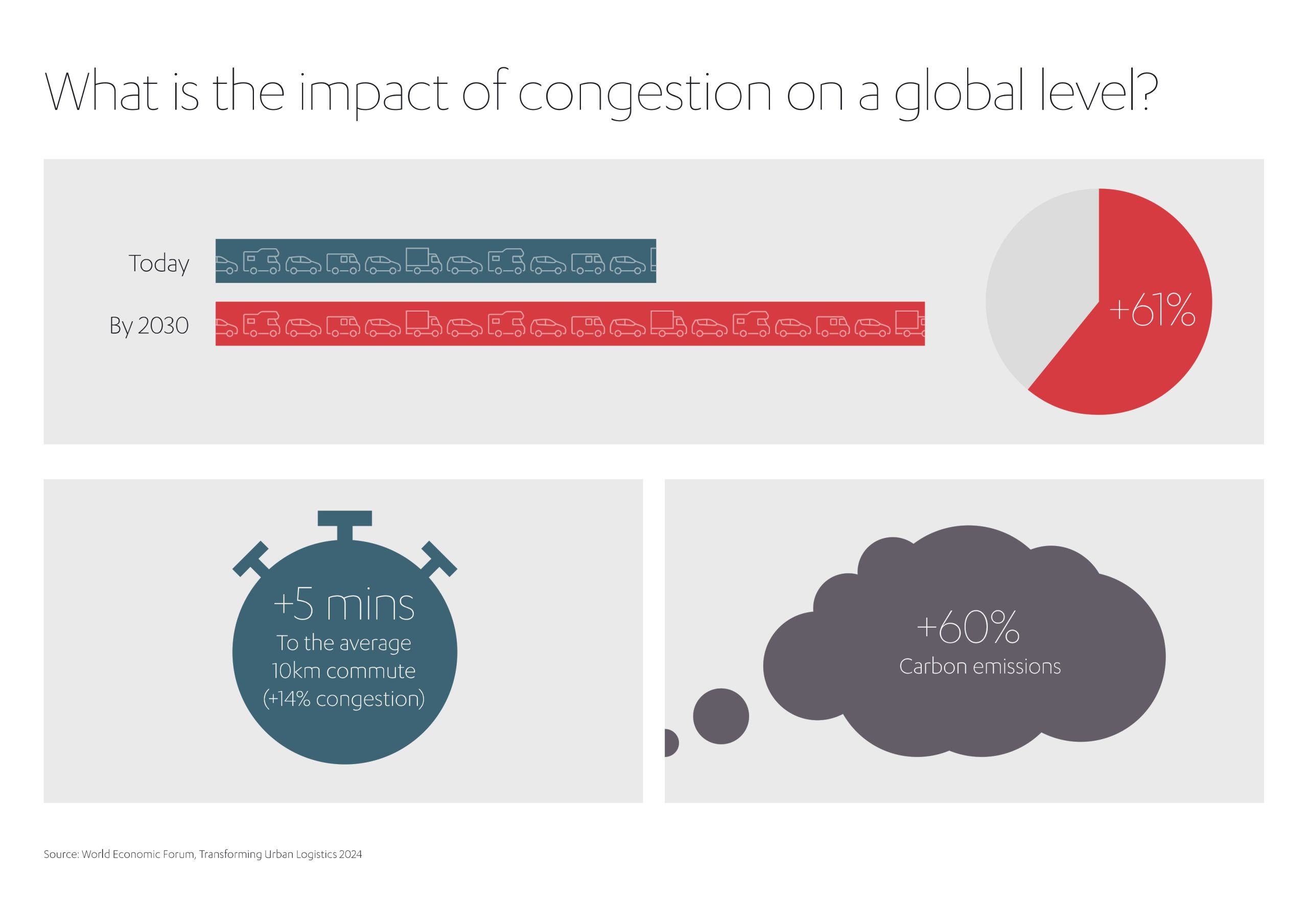
The growth of e-commerce is also a significant factor driving the increased number of vehicles on our streets. The World Economic Forum and Accenture warn of a 61% increase in delivery vehicles across all cities by 2030 based on current trends, worsening congestion by 14%. For an emerging city such as Bengaluru, the impact would be even higher, with an 84% increase in delivery vehicles projected.[15] The impact of goods vehicles on city congestion is disproportionate, taking up 20%-40% of motorized road while accounting for only 15%-25% of transport kilometers travelled.[16] And it’s not only about road use, but also wider disruption through issues such as double parking and blocking pedestrian and cycle routes.[17]
The growth of e-commerce is also a significant factor driving the increased number of vehicles on our streets
What is the impact of traffic congestion?
Getting stuck in traffic is frustrating and inconvenient. But the real impact of congestion extends far beyond that, concentrated on four key metrics:
Economic
Drivers waste time in traffic delays which they could be spending working or contributing to the leisure economy. According to INRIX’s research[18]:
- US drivers lost 49 hours to congestion in 2025, at a cost of US$ 894 per driver and US$ 85.8 billion to the country as a whole.
- The total cost of congestion to the UK and Germany, meanwhile, was estimated at £11 billion and €5.3 billion respectively.
The cost to individual cities can be substantial, with New York City losing US$ 9.7 billion and Los Angeles losing US$ 8.6 billion in 2025, according to INRIX data. The Mayor of London estimated the cost of congestion to the city’s economy in 2022 at £5.1 billion a year (£1,211 per driver).[19] In addition to lost time, vehicles use fuel less efficiently in traffic due to engine idling, repeatedly stopping and starting, wasted momentum and the use of low gears.
Environmental
Traffic congestion increases pollution, and not just because vehicles are spending longer on the road. The inefficient use of fuel in stop-start traffic leads to a disproportionately high increase in emissions of greenhouse gases and other pollutants.[20] Since road transportation contributes about a quarter (24%) of global carbon dioxide emissions[21], congestion is a significant factor impacting sustainability and air quality, as well as increasing noise levels.
The rise of e-commerce is set to play a significant role here. The WEF’s forecast increase in delivery vehicles by 2030 under a business-as-usual scenario would increase carbon emissions from deliveries by 60%, comprising approximately 54% of emissions from the transport sector.[22]
Health
Congested traffic in cities concentrates polluted air where populations are densest. When breathed in, nitrogen oxides in exhaust fumes can irritate the respiratory system, aggravating diseases such as asthma and potentially increasing the risk of respiratory infections. While long-term exposure may increase mortality risks from a range of diseases.[23] Fine particulate matter, known as PM 2.5, is also associated with a range of health problems, including respiratory, cardiovascular and neurological problems, due to the tiny particles getting into people’s lungs and bloodstream.[24]
Studies have also found that traffic congestion and its associated stress can negatively affect mental health[25], and that noise from road traffic significantly contributes to reduced health through problems such as sleep disturbance and ischemic heart disease. Research in Chittagong, Bangladesh, found that congestion increased road users’ frustration by 54% and anger by 89%, with a significant percentage experiencing problems such as headaches, fatigue and eye problems.[26]
Nitrogen oxides in exhaust fumes can irritate the respiratory system, aggravating diseases such as asthma and potentially increasing the risk of respiratory infections
Social
Congested roads have wide-ranging social impacts, which are no less serious for being difficult to quantify. As well as increasing stress, spending more time in traffic gives people less time for social connections, family life and local activities. This reduces people’s quality of life, which can ultimately have economic, health and other effects, for example, if they become unwell, decide to leave the area or grow less engaged with their community. A 2022 study from China found that “the longer the commute time workers use, the lower satisfaction with work and life they have”.[27] Longer travel times can also exacerbate inequality: wealthier residents can afford to live close to their work, while those on lower incomes are forced to commute long distances.
The growth of e-commerce, combined with other trends, is changing the dynamic of urban spaces and adding to congestion challenges. Delivery vehicles are competing with ride-hailing services, bike sharing schemes and EV charging for increasingly scarce curb space. As they search for a spot to park, drivers may block traffic lanes, footways or cycle paths – increasing congestion and creating safety concerns. Studies in Seattle have found that commercial drivers spend more than a quarter (28%) of their trip searching for parking[28] – and that commercial vehicles (mainly consisting of delivery vehicles) park in unauthorized locations 40% of the time.[29]
It’s not just human residents that suffer from congestion. Air and noise pollution, for instance, can impact wildlife populations[30], which in turn may have effects on local ecosystems, ultimately changing an area’s economic and social conditions in unpredictable ways. The effects of congestion are diverse but closely connected, presenting a complex challenge for policymakers. A University of Melbourne study found that pollution from trucks and buses costs Australians US$ 6.2 billion in health effects annually[31]: just one indication of the way issues cannot be addressed in isolation.
How are cities addressing congestion problems?
Cities and businesses are taking effective action on congestion in a number of ways. These include regulating traffic, redesigning spaces, investing in alternative transport, and reimagining approaches to deliveries.
Road pricing
Charging vehicles to use the road is one of the best-evidenced approaches for tackling congestion and its related problems. London introduced a congestion charge covering 21 square kilometers in 2003, with immediate impact. Within the first year, the city saw a 30% drop in traffic congestion, a 30% decrease in average speeds and a 38% rise in bus passenger numbers.[32] Analysis by the Organization for Economic Co-operation & Development (OECD) in 2022, however, found that the regained space was quickly filled by taxis and other service vehicles, which receive exemptions. As a result, the level of London’s road transport has remained fairly stable over the past two decades at about 20 billion vehicle miles a year, though the traffic situation would probably be much worse without the congestion charge.[33] In combination with low emissions zones, the policy is helping to improve the city’s air quality.[34]
Other cities have also seen fast results from road pricing schemes. After introducing a timed congestion charge in 2012, Milan reduced traffic within the relevant zone by 28% within two years. And since New York City introduced congestion pricing in January 2025, research has found traffic delays down by 25%[35], with fine particulate matter 22% lower than before[36].
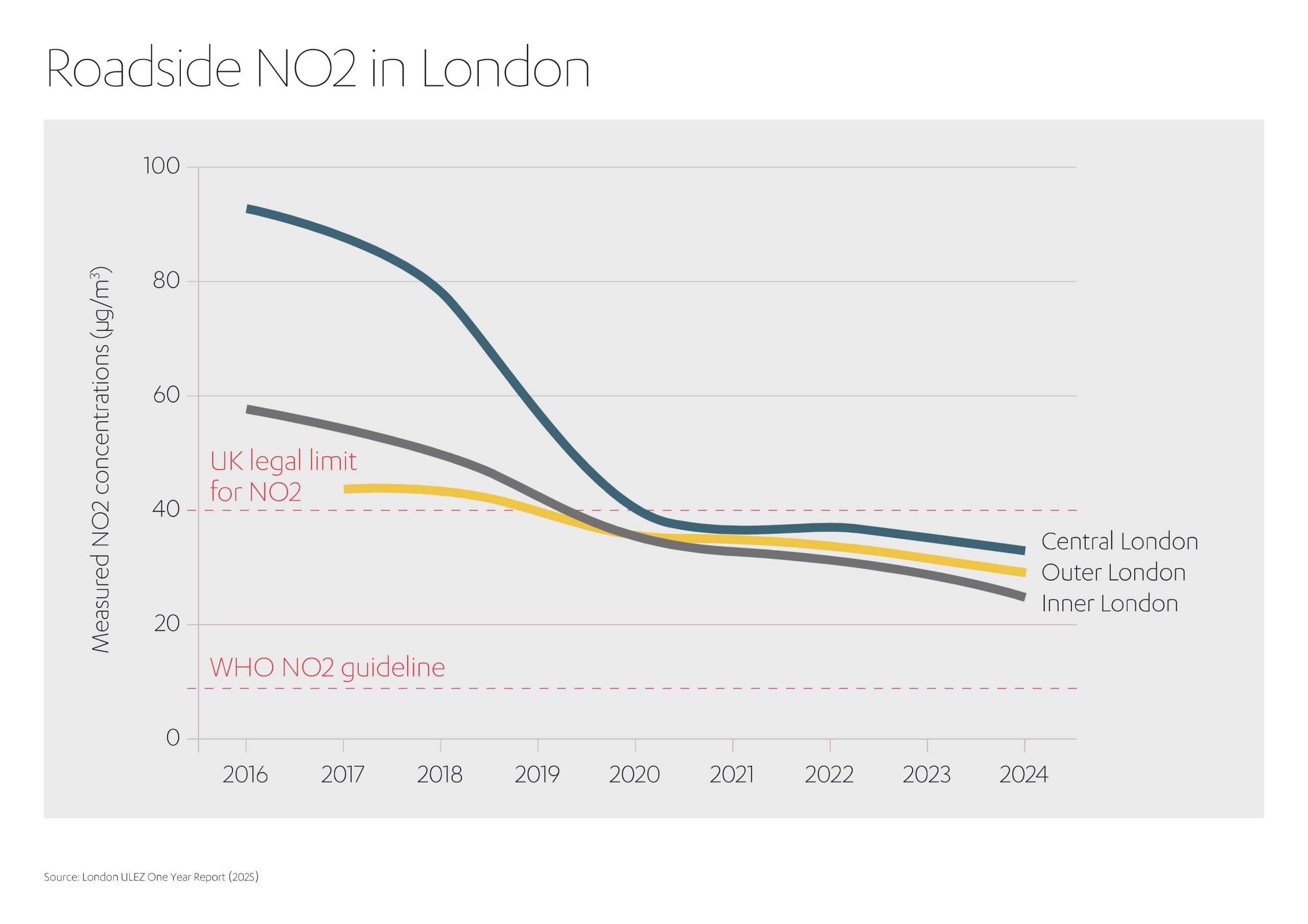
In focus: London’s low emissions zones– Beginning in 2008, London has deployed an increasingly stringent and wide-ranging series of low emissions zone policies to tackle air pollution. The initial low emissions zone (LEZ) applied to trucks, buses and coaches across most of Greater London. An ultra-low emissions zone (ULEZ) was brought in for the central congestion charge area in 2019 and expanded to cover the wider LEZ area in 2023. Implementing the ULEZ expansion was politically controversial, but London claims tangible results. A 2025 report found that 12 months later, levels of nitrogen dioxide were 27% lower across all of the city.
“I’ve been measuring air pollution in London for 30 years and it is hard to think of another urban-scale policy that has been as effective as the London ULEZ.”
Air pollution scientist Gary Fuller, Imperial College London[37]
Urban redesign
Faced with congestion and its associated problems, city planners and governments are considering a range of measures to address them, not only introducing specific policies but reimagining the city at a conceptual level. Some of the most comprehensive changes have taken place over the last two decades in Paris. Former mayor Anne Hidalgo championed the idea of the ‘15-minute city’, where residents can access local amenities through a short walk or bike ride. Research in 2024 found that almost 100 cities around the world were planning or implementing the 15-minute city, or a similar concept.[38] But it is likely the most effective measures will differ in each location.
In focus: Paris’ 15-minute city ambition – Mayor Hidalgo’s vision for a 15-minute city included changing the right bank of the Seine from a busy road used by 40,000 vehicles a day to a pedestrianized quayside, transforming schools into community hubs and increasing the amount of green space and cycle paths.[1] Paris now has more than 1,000km of cycle routes[1], and has removed 24,000 parking spots in the last six years.[1] Research found that between 2012 and 2022, the level of nitrogen dioxide in the city’s air fell by 40%. Fine particle pollution dropped by 28%, and carbon dioxide emissions by 35%.[1]
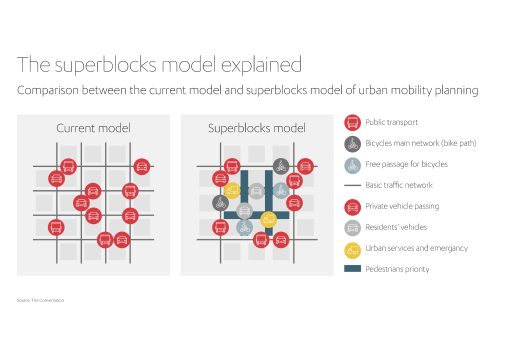
A simple but radical approach that has had an impact in Barcelona is ‘Superblocks’ (Superilles). Closing four road junctions in a grid of nine blocks allows road space to be reprioritized for pedestrians, cyclists and green spaces.[39] Some research suggests that rather than simply displacing car traffic, superblocks cause it to ‘evaporate’ as people avoid unnecessary trips.[40] In a 2025 study of three superblocks, people reported improvements in residents and workers in well-being, tranquility and quality of sleep, with reduced levels of noise and pollution, and more social interaction.[41]
Investing in alternative transport
To achieve the biggest impact, policies that aim to reduce road traffic should be implemented alongside investment in alternative forms of transport. High-quality public transport links can substantially reduce journey times and pollution. In Brazil, an extension to a metro line in São Paulo, which took place between 2010 and 2020, has reduced average travel times by 50%. The metro Line 5 extension transports around 500,000 passengers a day, of whom 56% of are women, and 58% are from low-income households.[42] The first phase of Dar es Salaam’s bus rapid transport (BRT) system, which opened in 2016, has also led to a 50% reduction in journey times, with some trips cut from three hours to 45 minutes. Like similar initiatives in other cities, the BRT network is intended to deliver a metro-like travel experience at a far lower cost, travelling along bus-only lanes via dedicated stations with pre-paid tickets. When completed, it is expected to carry 2 million passengers a day.[43]
Many locations continue to invest in cycling infrastructure, too, both between and within cities. This year Norway opened a new 13-kilometer ‘motorway for cyclists’ linking Stavanger to Sandnes, completely separate from cars and pedestrians.[44]
“Before the Bus Rapid Transit (BRT) we faced many challenges because the normal public buses took many hours on the road in traffic. Now with the BRT, transport has become easy. When you are going somewhere, you will get there in good time.”
A commuter on the BRT in Dar es Salaam, Tanzania.[45]
Rethinking deliveries
Faced with growing congestion as well as traffic regulation[46], e-commerce companies are increasingly using micromobility options (such as electric cargo bikes) rather than vans to complete the final stage of delivery more efficiently. Amazon now has a fleet of electric bikes, electric mopeds and pushcarts at more than 70 hubs across more than 50 European cities, delivering to city centers and residential areas.[47] There is also potential for businesses to operate shared hubs: a pilot in Berlin including five of the largest parcel operators delivered 160,000 parcels by e-cargo bike, saving 11 metric tons of carbon dioxide.[48] Other efficiency-increasing initiatives include parcel pick-up, drop-off (PUDO) networks such as parcel lockers and shops: in the UK, Evri intends to double its PUDO network to 25,000 by 2030 through a £50 million investment[49]. Delivery robots have also been introduced in some cities, though they are not always welcomed.[50]
Many city administrations are exploring new ways to manage delivery-related issues, such as using digital technology and data to support clearer curb management. Since 2022, Pittsburgh, USA, has used digital cameras and machine learning to implement smart loading zones, increasing turnover in the zones by 40% and cutting average stay times by 23%.[51]
“Our growing number of micromobility hubs represent the future of urban delivery. Smaller electric vehicles and push carts allow our delivery partners to maintain a fast, reliable service while significantly reducing our environmental impact in the communities we serve.”
Andreas Marschner, Vice President of Worldwide Sustainable Operations, Amazon
How will cities manage congestion in future?
Approaches may vary widely, but experience to date shows that it is possible to reduce congestion and address its effects. The combined potential of electric power, data, digital technology and fresh thinking mean this is often a route to developing more pleasant and productive urban environments in ways that extend far beyond simply reducing traffic.
From drone delivery to self-drivingwater taxis[52], the range of possible solutions is huge. But to ensure success, strategies must involve input from everyone affected. Rotterdam’s Logistiek 010 community[53], which includes around 3,000 logistics companies alongside government, knowledge and educational organizations, is one example of an established collaborative approach. Detroit’s Transportation Innovation Zone, meanwhile, demonstrates how a city can responsibly support the rapid trial of new mobility technology.[54] The complex nature of congestion means responding to it must be a collective effort: getting people moving again is also about bringing them together.
Five fast facts: The real cost of traffic congestion
Q: Is traffic congestion getting worse?
A: In most places, yes. Traffic delays in 2025 increased in 62% of the urban areas analyzed by INRIX, up from 55% the year before, while TomTom recorded global congestion rising from 20% to 25%.
Q: What does congestion cost drivers?
A: More than most realize. US drivers each lost 49 hours to congestion in 2025, at a cost of US$ 894 per driver and US$ 85.8 billion nationally. New York City alone lost US$ 9.7 billion.
Q: Is congestion just an economic problem?
A: No, there are substantial wider costs to the environment and society. Road transport contributes about a quarter (24%) of global carbon dioxide emissions, and poor air quality measurably worsens human health.
Q: Does charging drivers reduce traffic?
A: Yes – it’s one of the best-evidenced tools. London’s congestion charge cut traffic by 30% in its first year, and New York’s 2025 scheme has reduced delays by 25% and fine particulate matter by 22%.
Q: Can tackling congestion make cities better places to live?
A: Absolutely. Through its ‘15-minute city’ ambition, Paris has added more than 1,000km of cycle routes and cut CO2 emissions by 35% between 2012 and 2022. Similarly, Barcelona’s ‘Superblocks’ have reclaimed street space for people, with residents reporting less noise, better sleep and more social connection.
[1] https://inrix.com/scorecard/
[2] https://www.tomtom.com/newsroom/press-releases/general/136190136013341/traffic-index-us-ranks-among-worlds-least-congested-countries-despite-gridlocked-cities/
[3] https://www.tomtom.com/newsroom/press-releases/general/136190136013341/traffic-index-us-ranks-among-worlds-least-congested-countries-despite-gridlocked-cities/
[4] https://www.un.org/en/desa/latest-urbanization-data-reveal-world’s-most-populous-cities
[5] https://www.sciotoanalysis.com/news/quick-analysis-do-high-housing-prices-cause-longer-commutes
[6] https://asiantransportobservatory.org/insights/cop29-primer-insight-13/
[7] https://www.tomtom.com/newsroom/explainers-and-insights/induced-demand-explained/
[8] https://www.sciencedirect.com/science/article/abs/pii/S0967070X18301720
[9] https://www.shiply.com/articles/us-car-ownership-statistics
[10] https://www.ipsos.com/en/the-death-of-car-ownership
[11] https://www.statista.com/outlook/mmo/passenger-cars/worldwide/?srsltid=AfmBOop36gWDuhSR3gY0i4AHqSt9bRf–ue0QJxkYbrTqp_Z_YkR8YhL#unit-sales
[12] https://www.worldbank.org/en/results/2024/03/13/promoting-livable-cities-by-investing-in-urban-mobility
[13] https://latamobility.com/en/car-sales-in-colombia-skyrocket-april-2026/
[14] https://itdp.org/2025/09/04/global-cities-can-still-turn-the-tide-on-car-centric-growth/
[15] https://reports.weforum.org/docs/WEF_Transforming_Urban_Logistics_2024.pdf
[16] https://www.oecd.org/content/dam/oecd/en/publications/reports/2024/06/urban-logistics-hubs_1c944796/da4dee9f-en.pdf
[17] https://www.weforum.org/stories/urban-transformation/sustainable-deliveries-cities-companies-logistics/
[18] https://inrix.com/scorecard/
[19] https://www.london.gov.uk/press-releases/mayoral/cost-of-congestion-in-capital-revealed
[20] https://www.sciencedirect.com/science/article/abs/pii/S1364032125009219
[21] https://www.sciencedirect.com/science/article/abs/pii/S1364032125009219
[22] https://reports.weforum.org/docs/WEF_Transforming_Urban_Logistics_2024.pdf
[23] https://www.nature.com/articles/s41467-025-56963-y
[24] https://www.sciencedirect.com/science/article/pii/S2666765724001212
[25] https://pmc.ncbi.nlm.nih.gov/articles/PMC12975094/
[26] https://www.sciencedirect.com/science/article/pii/S2666691X22000203
[27] https://pmc.ncbi.nlm.nih.gov/articles/PMC9819363/
[28] https://www.sciencedirect.com/science/article/pii/S0967070X20302274?via%3Dihub
[29] https://urbanfreightlab.com/wp-content/uploads/2023/04/Commercial-Vehicle-Parking-in-Downtown-Seattle-Insights-on-the-Battle-for-the-Curb.pdf
[30] https://www.eea.europa.eu/en/european-zero-pollution-dashboards/indicators/impacts-of-environmental-noise-on-biodiversity-signal-1
[31] https://www.theguardian.com/environment/2026/feb/22/air-pollution-emissions-trucks-buses-australia-health-effects
[32] https://www.c40knowledgehub.org/s/article/How-road-pricing-is-transforming-London-and-what-your-city-can-learn
[33] https://www.oecd.org/en/publications/ipac-policies-in-practice_22632907-en/london-s-congestion-charge-and-its-low-emission-zones_c6cd48e9-en.html
[34] https://www.c40knowledgehub.org/s/article/How-road-pricing-is-transforming-London-and-what-your-city-can-learn
[35] https://www.governor.ny.gov/news/six-months-governor-hochul-highlights-success-congestion-pricing-traffic-down-business-and
[36] https://news.cornell.edu/stories/2025/12/congestion-pricing-improved-air-quality-nyc-and-suburbs
[37] https://www.c40knowledgehub.org/s/article/How-road-pricing-is-transforming-London-and-what-your-city-can-learn
[38] https://www.sciencedirect.com/science/article/pii/S0965856424002829
[39] https://www.sciencedirect.com/science/article/pii/S0013935124004547
[40] https://www.sciencedirect.com/science/article/pii/S0013935124004547
[41] https://link.springer.com/article/10.1186/s12889-025-21835-z
[42] https://www.worldbank.org/en/results/2024/03/13/promoting-livable-cities-by-investing-in-urban-mobility
[43] https://www.worldbank.org/en/results/2024/03/13/promoting-livable-cities-by-investing-in-urban-mobility
[44] https://momentummag.com/norway-opens-13-kilometre-cycling-superhighway-connecting-stavanger-and-sandnes/
[45] https://www.worldbank.org/en/results/2024/03/13/promoting-livable-cities-by-investing-in-urban-mobility
[46] https://micromobility.io/news/the-new-last-mile-how-micromobility-is-reshaping-urban-delivery
[47] https://www.aboutamazon.eu/news/sustainability/amazon-announces-100-million-deliveries-in-europe-completed-using-electric-cargo-bikes-electric-mopeds-and-pushcarts
[48] https://marketplace.eiturbanmobility.eu/best-practices/decarbonising-urban-logistics-with-cooperative-micro-depots-in-berlin
[49] https://motortransport.co.uk/operator-news/evri-to-double-parcelshop-and-locker-network-with-50m-investment/26473.article
[50] https://www.bbc.co.uk/news/articles/c0rygp005wjo
[51] https://www.weforum.org/stories/urban-transformation/sustainable-deliveries-cities-companies-logistics/
[52] https://reports.weforum.org/docs/WEF_Combatting_Congestion_2025.pdf
[54] https://detroitmi.gov/government/mayors-office/office-mobility-innovation/transportation-innovation-zone


 Dubai, United Arab Emirates September 28 , 202616 minute read