

 Dubai, United Arab Emirates September 28 , 2026
 16 minute read
Could Mobility-as-a-Service transform urban transport?
Dubai, United Arab Emirates September 21 , 202620 minute read
The concept of Mobility-as-a-Service (MaaS) presents a utopian vision for the future of urban transport: Ultra-convenient door-to-door travel, no need to own a private vehicle, and a reduced carbon footprint for the mobility sector. So why hasn’t MaaS taken the world by storm?
A viable alternative to privately-owned automobiles is, probably, long overdue. Road travel is now responsible for up to three quarters of all transport emissions. Without intervention, cars could carry an even higher carbon toll in the coming decades, with a predicted threefold rise in passenger and freight demand by 2070.[1]
Regardless of these apparent advantages, MaaS is proving slower to catch on than many experts anticipated. Despite a significant roll-out of MaaS projects worldwide, not everyone is ready to embrace the concept of mobility based on access not ownership, and some schemes have withered in the glare of commercial reality. As of 2026, research shows that cars still account for some 70% of all miles traveled in towns and cities.[2]
To comprehend how a coordinated push behind MaaS could cut journey times, save passengers money and help offset global warming, we must first understand what the concept entails, and how it dovetails with modern technology.
What is Mobility as a Service?
MaaS asks city travelers to stop and think again. If we have a journey to make, the first instinct is perhaps to reach for the car keys and head for the door. Under a MaaS scenario, we are encouraged instead to reach for the smartphone, open our city-wide MaaS app, and find a more efficient and sustainable way to travel.
Convenience is key to mass adoption, which is why MaaS reimagines journeys as a single, connected experience rather than a series of separate trips. It enables people to plan, book and pay for an entire trip through one digital platform.
MaaS reconfigures mobility as a continuous service, helping to bridge the gaps between various modes of transport
A sophisticated MaaS ecosystem can incorporate multiple forms of transport: Trains, buses, trams, ride-hailing services, taxis, micromobility options such as shared bicycles and e-scooters, and even emerging autonomous vehicles.
Traditionally, sacrificing private car ownership meant accepting fragmented public transport, with inconvenient transfers and uncertainty over delays. MaaS instead reconfigures mobility to bridge the gaps between various modes of transport so journeys are smoother and waits substantially reduced.
Is the Mobility-as-a-Service sector growing?
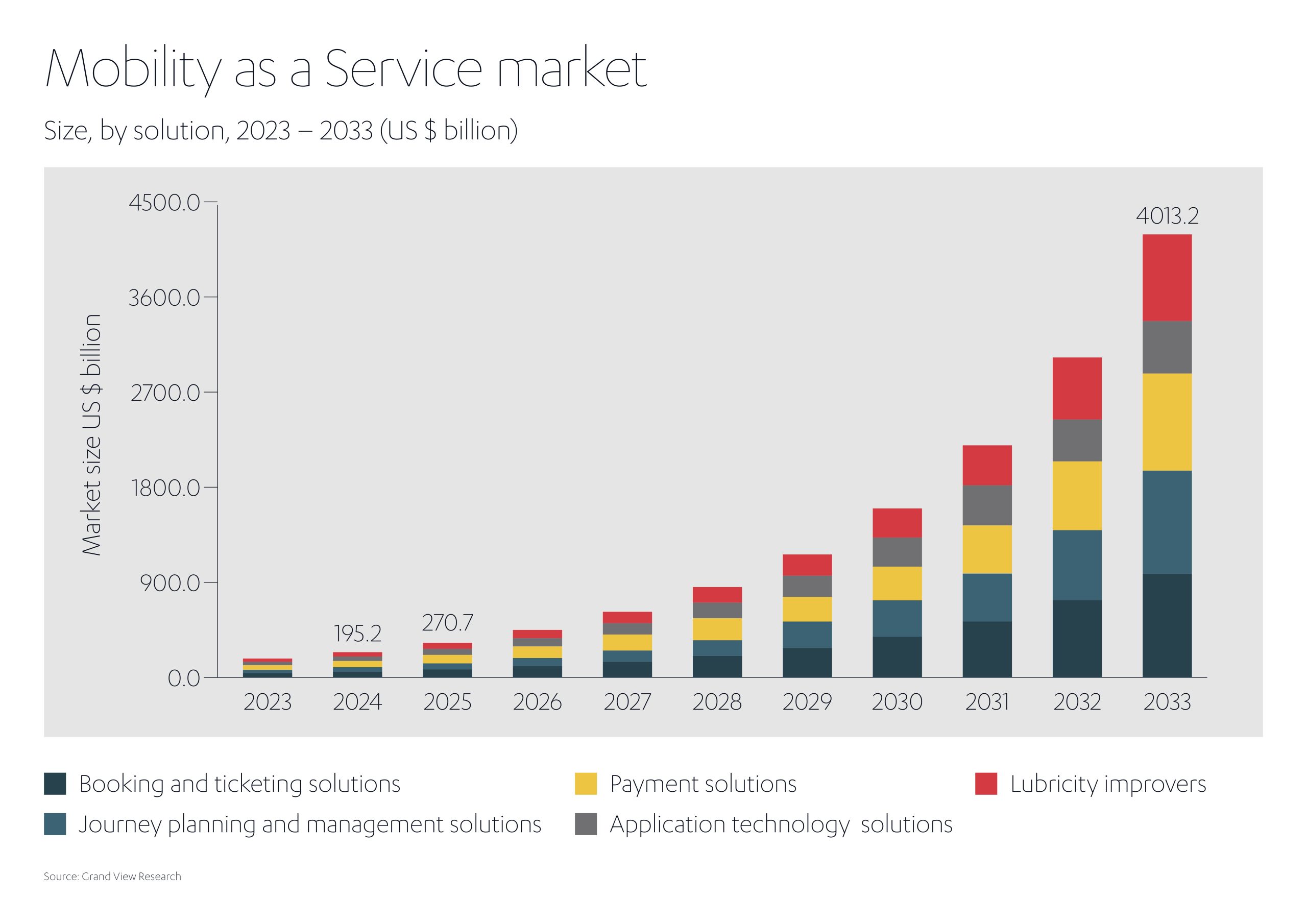
As new MaaS schemes continue to emerge, market value is set to soar. In 2025, the MaaS market grew 38% over the previous 12 months, achieving a new record valuation of US$ 270 billion, with Europe identified as the largest market and Asia-Pacific the fastest growing.[3] Revenue is split between multiple components:
- Booking and ticketing solutions
- Payment providers
- Journey planning and time management services
- Application technology developers
The sector is predicted for further expansion in 2026, to an estimated market size of US$ 377 billion, and to US$ 4 billion by 2033 for a CAGR of 40.1%.[4] So what lies behind these optimistic growth predictions?
What factors are fueling the rise of MaaS?
Technological advances appear to be finally elevating MaaS ecosystems into the mainstream. Advances include:
- 5G: Mobile communication technology can now transfer data at unprecedented speeds, while greatly expanding network capacity and allowing more responsive real-time interactions. Better connectivity means faster and more straightforward journey planning, enabling the simultaneous connection of vast numbers of devices.
- Contactless payments: In cities around the world, modern infrastructure is increasingly permitting contactless payment methods, Quick Response (QR) codes and digital tickets, ensuring users a seamless payment experience.
Transport planners can access a wealth of data directly from users and these insights can help them to make game-changing improvements with confidence
- MaaS integration: Travel companies and public transport providers are gradually integrating MaaS services into their existing apps. Multimodal journey planning and single-point payment systems provide a customer-friendly experience and encourage repeat use.
- Transport planning: Urban transport planners can access a wealth of data directly from users. These insights can help them to make game-changing improvements with confidence: Realigning public transport networks to reflect changing customer needs, cutting road congestion, or fine-tuning spending priorities.
- Smart cities: By connecting vehicles, infrastructure and travelers through sensors and high-speed communication networks, smarter cities enable MaaS providers to streamline multiple transport strands, more effectively controlling the flow of people through urban environments.
- Autonomous vehicles: The rise of autonomous vehicles could prove transformative for MaaS by making shared mobility more affordable, flexible and frequent. Driverless shuttles and robotaxis can reduce operating costs by matching supply with demand, while also extending services to underserved districts.
How can car-sharing schemes help promote MaaS?
If we want people to rethink their traditional attitudes towards owning their own vehicle, we must present them with a valid alternative. One option is the car-sharing model, which is proving that access is more important than ownership.
Car-sharing is a pillar of the MaaS vision, one which is further weakening the traditional link between mobility and ownership. When combined in a single platform alongside public transit, bike-hiring and ride-hailing, car-sharing can almost match the flexibility of a private vehicle. It can also negate the need to own a private car, which is likely to remain unused for most of the day.
The car-share sector has expanded steadily over the past 10 years. Research shows the number of vehicles available from station-based or free-floating car-share schemes has increased fivefold in a decade.[5] With the pool of vehicles vastly larger than ever before, millions of customers have joined car-share schemes worldwide. Membership levels are forecast to approach 270 million in 2027, when participating vehicle numbers could approach the one million mark[6].
Leading markets include North America, Europe, South Korea and Japan, with major schemes operating in cities such as Berlin, Paris, Madrid and Vancouver.
CASE STUDY – FREE2MOVE: Free2Move is a Europe-wide car-sharing service allowing users to rent vehicles on-demand by the minute, hour, or day. Operated by global automaker Stellantis, Free2Move provides a database of free-floating cars available at short notice to individual or corporate customers across Europe and America. For convenience, parking, fuel, and insurance are automatically included in the rental price. Registered motorists can locate, unlock and drive away vehicles via a user-friendly smartphone app, with no obligation to return them to point of origin. It is a tempting solution for those seeking a last-minute option, with none of the inconveniences of owning a car such as road tax, MOTs or garage bills. Free2Move, which grew at a CAGR of 99% between 2021 and 2024, currently boasts six million customers and around 450,000 rental vehicles worldwide.
For MaaS users, the rise of car-shares fills an important niche, simplifying access to areas poorly served by public transport, while sidestepping the need for private ownership.
Which cities are leading the MaaS initiative worldwide?
There are examples of MaaS innovation in operation across the globe. Some of the larger and more ambitious models can serve as a template for others seeking a similar transit revolution.
- Singapore: Singapore has divided its MaaS offering into two separate systems: Grab, for private ride-hailing, and SimplyGo, for public transport. SimplyGo allows contactless swiping on all buses and trains and has made physical tickets redundant. Grab is a national success story, with 41% of the population routinely using the app for taxis, perishables (GrabFood), groceries and medicines (GrabMart), or secure document and parcel delivery (GrabExpress). Grab brings more than US$ 4 billion to the Singaporean economy annually, either through its own operations or via merchant or driver partners. Together, they support more than 100,000 earning opportunities each year while generating around US$ 2 billion in household income for citizens.[7]
CASE STUDY – Berlin, Germany: Thanks to sustained investment, the German capital has become a testbed for multimodal MaaS innovation. Berlin’s Jelbi platform integrates public transit options with private micromobility providers, such as Lime and Voi, through a single interface and payment mechanism. Transport company BVG, which operates Jelbi, is now used for more than one billion journeys every year. These partnerships demonstrate how public agencies and commercial operators can collaborate on a comprehensive MaaS service sufficiently user-friendly for mass adoption
- Los Angeles, USA: The city’s MaaS strategy has been shaped by the need to navigate a vast, car-centric metropolis. LA’s regional Transit Access Pass (TAP) offers door-to-door journey planning across buses, light rail, bike-sharing and other services, from a range of micromobility and ride-hailing providers.
- Vienna, Austria: Austria has two competing MaaS systems. The Austrian Federal Railway Company co-founded iMobility to develop its Wegfinder app, providing multimodal travel information and ticketing across the country. In the capital, the City of Vienna Utility Company partnered with Upstream to create its own WienMobil app, coordinating metro, tram and bus services with cars, bikes and taxis. WienMobil’s forerunner, the SMILE (Simply MobILE) app, was credited with a 21% fall in car journeys in Vienna, a 22% increase in train travel, and a 22% uptick in bike-sharing.[8]
- Dublin, Ireland: Dublin City Council and Enterprise Ireland worked together to create the MyMobilityHub app, equipping travelers in the Irish capital with real-time journey planning data.
CASE STUDY – Dubai, UAE: The emirate’s S’hail app, developed by the Roads and Transport Authority (RTA), combines journey planning and payment for the metro, trams, marine transport and taxis. The app has allowed the RTA to introduce a flexible, dynamically-routed minibus service, with passengers summoning buses according to demand rather than waiting for fixed timetables. In 2025, active users of the S’hail app surpassed 1.2 million people, with app visits hitting 68 million (a 144% rise from 2024) and journey queries reaching 48 million (up 48% in a year). In the private sector, rival super-app Careem runs a ride-hailing service, as well as coordinating food and grocery deliveries.
The app, bringing together public transport, hire bikes and e-cars, also allows users to generate a sustainability score for their trips and plan the greenest route possible. In one pilot program, public sector workers saved 2.5 tons of carbon emissions in a year by altering their travel habits.[9] The Irish government’s National Sustainable Mobility Policy proposes expanding the app’s ticketing, automated vehicle location and journey planning functions nationally. It aims to encourage a 130% increase in public transport journeys and a 20% reduction in total vehicle kilometers travelled.[10]
With such gold-standard examples of MaaS integration worldwide, it is perhaps surprising that such blueprints are not being adopted more rapidly by the world’s major economies. What is holding back greater MaaS utilization?
What is hindering the faster roll-out of MaaS services worldwide?
Despite progress, the rate of MaaS adoption in urban centers worldwide has failed to keep pace with more optimistic projections. Some observers cite one-size-fits-all technology solutions as a limiting factor. A more bespoke approach, they argue, which addresses the unique socio-economic and geographical challenges of a particular area, would produce more meaningful results. Any durable MaaS package should offer added value for customers and cities, while catering to specific overlooked groups and supporting wider mobility goals.
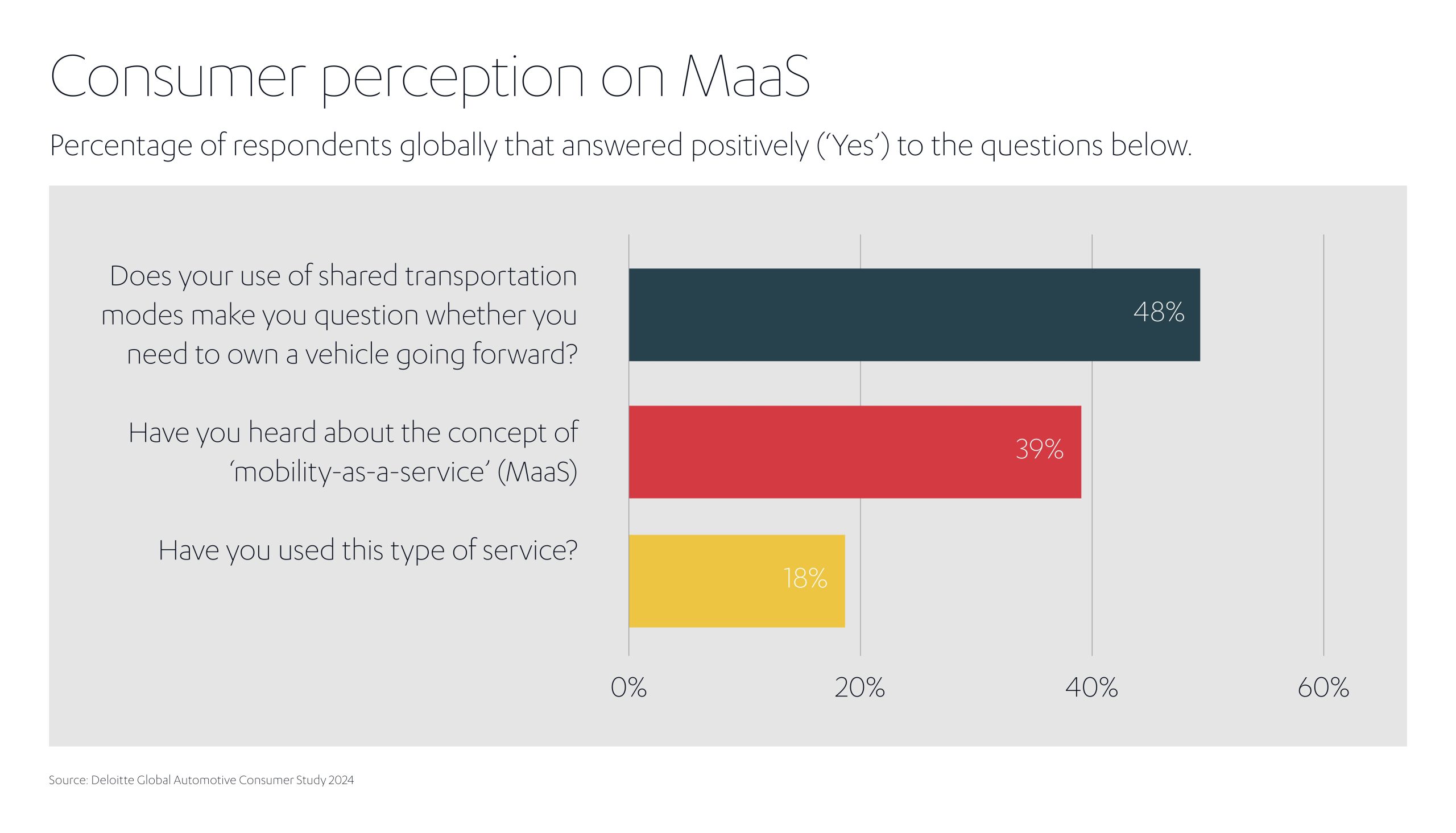
Lack of awareness about MaaS remains a barrier to faster project rollouts. Only around 39% of consumers worldwide have heard about MaaS as a concept, while fewer than two-in-ten have personally used such a service.[11] Further complicating the picture, regions including Asia and Europe have aging populations, a demographic that tends to be less digitally literate and more reliant on personal vehicles than their younger counterparts.
High initial start-up costs and tight profit margins make it challenging for providers to develop sustainable business models without reliance on state subsidies
Then there’s the cost. A sophisticated MaaS ecosystem comes at a steep financial price. High initial start-up costs and tight profit margins make it challenging for providers to develop sustainable business models without reliance on state subsidies.
Collaboration can be an issue. Partnerships between different stakeholders are essential for an effective MaaS proposition, but private transit operators are understandably protective of their data, limiting the potential for transparent partnerships.
Telecommunications need to continue evolving to leverage the full potential of MaaS. Although the expansion of 5G mobile technology is progressing worldwide, some areas still survive with only 2G, 3G or 4G coverage, essentially excluding themselves from many of the benefits of smart city living until communications improve.
Public perceptions also present challenges. MaaS providers face an ongoing battle to win the public’s hearts and minds. Micromobility devices such as e-bikes and scooters are routinely in the headlines for the wrong reasons, either for causing accidents, or for being vandalized and abandoned in unsightly fashion.
Some MaaS schemes have already faltered:
- In December 2025, car-sharing company ZipCar ceased all operations in London[12]. With 650,000 UK members the company had become the country’s largest car-sharing provider, with users renting vehicles by the hour or day through a smartphone app. The cost-of-living crisis was blamed for after-tax losses, widening to £11.6m before closure.
- A public referendum in Paris in 2023 saw citizens vote to outlaw electric rental scooters after they were involved in a spate of injuries in the French capital[13].
- In 2024, Finnish mobility startup Maas Global, creator of travel app Whim, closed down just short of its 10th anniversary[14]. Whim had around 10,000 monthly users in Helsinki alone, and an active presence in Antwerp, Tokyo, Birmingham and Vienna. In the aftermath, failure was blamed on a lack of funding and a cash-intensive business model.
- Barcelona is banning private scooter operators including Lime, Voi and Bird, due to widespread parking and road violations, leaving only the state-run ‘Bicing’ service struggling to meet demand[15].
If we believe in the democratic and environmental principles of a functioning MaaS ecosystem, we have to learn from these missteps and plot a viable way forward.
Practical steps: How can we accelerate the growth of MaaS?
Mobility as a Service has already demonstrated its technical potential. The next challenge is achieving wider public adoption and developing more convincing business models.
Success will hinge upon governments, transport operators and technology providers taking coordinated action to:
- Raise MaaS’ profile: Many potential users remain unaware of the convenience MaaS can offer. Advocacy must extend beyond smartphone app stores, instead using advertising, transport hubs and public information campaigns to encourage travelers to discover the benefits of MaaS for themselves.
- Deliver a more holistic customer experience: Successful MaaS platforms should offer more than just journey planning. Features such as personalized recommendations, integrated event ticketing and parking information can make platforms more valuable, encouraging repeat use.
- Engage employers and businesses: Corporate mobility represents a significant opportunity for expansion. Employers are increasingly seeking low-carbon travel options, both to support sustainability targets and to attract talent. Mobility budgets and business travel packages could rapidly increase MaaS usage, while helping organizations meet their environmental, social and governance (ESG) promises.
- Build stronger public-private partnerships: No single organization can deliver a comprehensive MaaS solution. Public authorities, transport operators and technology companies must work together to coordinate services and share expertise capable of supporting long-term projects.
- Unlock the value of shared data: MaaS depends upon the free flow of reliable information between transport providers. Governments must help to develop consistent data-sharing frameworks that protect privacy while enabling large networks to operate seamlessly.
- Design pro-MaaS regulation: Public policy can help accelerate MaaS by aligning financial incentives with sustainable travel. Measures such as integrated ticketing, universal technical standards, and investment in digital infrastructure, can all make shared mobility more attractive. Similarly, tactical disincentives such as road taxes and city charging zones can reduce reliance on private vehicle ownership.
As we have seen, the future of MaaS depends not only on smarter technology but also on stronger partnerships, better governance and a more customer-focused mindset. If we can meet these priorities, prospects for the future of MaaS are extremely encouraging.
What does the future hold for MaaS?
We are still in the relatively early days of Mobility as a Service, a concept which could in the near future become a mainstay of city living. Studies show that with strong coordination and ambitious funding, policymakers could double the global share of sustainable mobility from 30% to 60% of all passenger mileage over the next decade.[16]
Low-carbon transport solutions are especially important in low- and middle-income countries (LMIC). These population hubs are expected to account for 90% of global population growth by 2050.[17] They could cut their urban transport emissions by 40%-70% if they pursued a more rapid shift to public transport and greener vehicles.
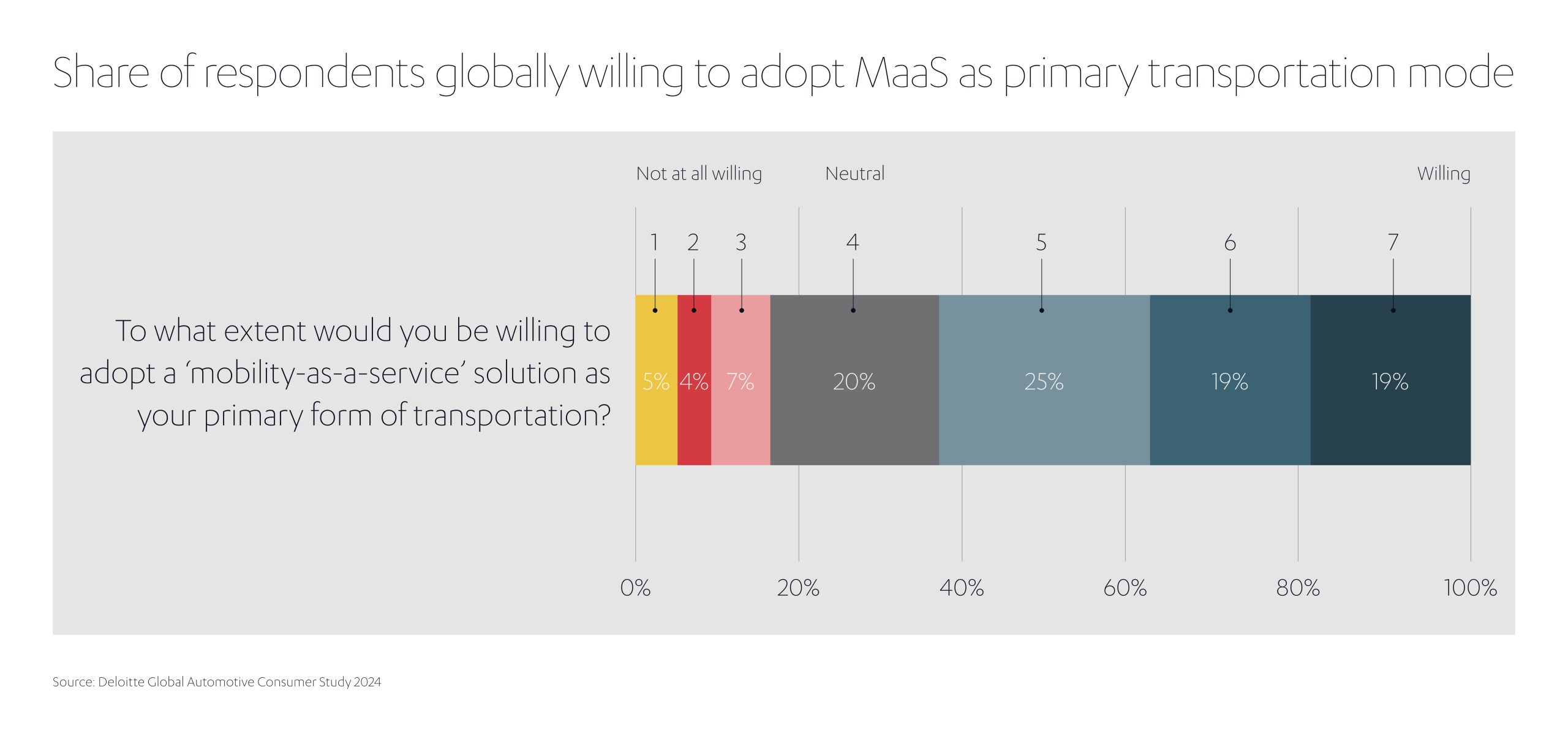
The public, it appears, is ready for the transition. In one survey, almost half of all motorists admitted that the potential rise of shared transportation would make them reconsider personally owning a car.[18] In a separate study, almost two-thirds of 27,000 respondents expressed willingness to embrace MaaS as their primary mode of travel, with only 16% holding negative views.[19]
New deals continue to emerge, demonstrating genuine momentum behind Maas.
In the USA, Uber Transit is investing millions of dollars to help public transport chiefs trial on-demand mobility services.[20] Among them, key workers and night shifters in Texas will gain a new after-hours program funneling users toward Uber cars when public transport scales down for the night. In San Juan, Puerto Rico, a new scheme will offer discounted first-mile/last-mile rides to 16 rail stations, a vita lifeline for areas with overstretched bus services.
In Southeast Asia, super-app Grab is joining forces with Chinese auto giant BYD to provide 50,000 new EVs for its driver-partners.[21] The arrangement will help commercial drivers overcome the initial EV investment hurdle. It will also encourage a higher proportion of zero carbon travel, by enabling passengers to specify eco-friendly rides, ensuring the vehicle arriving at the curbside will be all-electric.
In the UK, Transport for London is working with American tech firm Via Transportation to improve MaaS options across multiple boroughs.[22] New online portals are expanding access to the city’s Dial-A-Ride scheme, which substitutes conventional bus routes for on-demand door-to-door services. The digital expansion is already helping tens of thousands of elderly or disabled users, who cannot reach ordinary bus stops and interchanges, to navigate the city.
Across Europe, meanwhile, the European Parliament is developing a new Multimodal Digital Mobility Services bill to support the growth of digital one-stop-shop MaaS platforms by encouraging open data sharing. European Parliament research suggests that by 2030 cross-border mobility platforms could attract 500 million new travelers, with a 50% growth in intercity transport and 172 million new high-speed rail users.[23]
Micromobility innovators also continue to flourish. Greaves Electric Mobility, for example, in which Abdul Latif Jameel is a major investor, is one of India’s leading two-to-three-wheeler mobility companies. In 2027 it will launch its Ampere 6th Gen Electric Scooter, designed to challenge the country’s well-established petrol scooter market. The new model features improved software integration and targets 50% lower running costs than ICE equivalents. In further milestones, 2025 saw Greaves’ Eltra City XTRA electric three-wheeler complete a 324 kilometer journey from Karnataka to Tamil Nadu on a single charge – a new Indian record.
The Jameel family’s other mobility operations – a network under the Jameel Motors banner, including some of the world fastest growing EV brands – now span multiple countries across Asia, Africa, Europe, America and Australia, with recent expansion into upcoming markets such as Poland, Italy and South Africa.
“With sound legislative, technological and financial backing, the new impetus behind MaaS could be transformative news for our communities”
“MaaS marks a fundamental change in how we think about mobility and promises the prospect of truly personalized travel,” says Fady Jameel, Vice Chairman, International, Abdul Latif Jameel. “Society is very gradually moving away from transport systems centered on private vehicle ownership, toward a model in which journeys are delivered through public, private and shared mobility services.”
“By learning from previous missteps, and with sound legislative, technological and financial backing, the new impetus behind MaaS could be transformative news for our communities: Faster, cheaper and more convenient journeys, a greatly reduced carbon footprint, and better access for all.”
Five Fast Facts: Mobility as a Service
Q: How big is the global MaaS market expected to be in 2026?
A: An estimated US$ 377 billion, up from US$ 270 billion in 2025 – a sector on track for a 40.1% compound annual growth rate through 2033.
Q: What share of urban miles are still driven by cars, despite the rise of MaaS?
A: Around 70% of all miles traveled in towns and cities, as of 2026.
Q: How much did car-sharing schemes grow over the last decade?
A: The number of vehicles available through car-share schemes increased fivefold, with membership forecast to approach 270 million by 2027.
Q: How many people worldwide are aware of Mobility as a Service?
A: Only about 39% of consumers have heard of the concept, and fewer than one in five have ever used a MaaS service.
Q: Is the general public enthusiastic for the expansion of MaaS?
A: In one survey, almost half of all motorists admitted the rise of shared transportation would make them less likely to own a car. Another study showed almost two-thirds of respondents would be open to using MaaS as their primary mode of travel.
[1] https://www.gsma.com/solutions-and-impact/connectivity-for-good/mobile-for-development/blog/greener-journeys-how-mobility-as-a-service-is-driving-climate-impact/
[2] https://www.smartcitiesdive.com/news/urban-mobility-traffic-policy-opinion-arthur-little/817922/
[3] https://www.grandviewresearch.com/industry-analysis/mobility-as-a-service-market-report
[4] https://www.grandviewresearch.com/industry-analysis/mobility-as-a-service-market-report
[5] https://invers.com/en/academy/global-car-sharing-market-size
[6] https://insurance-canada.ca/2025/03/03/berg-insight-carsharing-telematics-market/
[7] https://www.oxfordeconomics.com/resource/the-economic-impact-in-singapore/
[8] https://scag.ca.gov/sites/default/files/2024-05/maas-feasibility-white-paper-0722.pdf
[9] https://scag.ca.gov/sites/default/files/2024-05/maas-feasibility-white-paper-0722.pdf
[10] https://www.gov.ie/en/department-of-transport/publications/national-sustainable-mobility-policy/
[11] https://www.deloitte.com/content/dam/assets-shared/docs/industries/consumer/2024/resetting-the-maas-idea.pdf
[12] https://www.bbc.co.uk/news/articles/cp8zv1gr0z9o
[13] https://www.bbc.co.uk/news/world-europe-66682673
[14] https://menafn.com/1108011167/The-Whim-Travel-App Signify-The-End-Of-The-Road-For-Mobility-As-A-Service-Model
[15] https://road.cc/news/barcelona-to-ban-private-bike-share-schemes-from-2027-as-mayor-slams-e-bike-parking-mess
[16] https://www.smartcitiesdive.com/news/urban-mobility-traffic-policy-opinion-arthur-little/817922/
[17] https://www.gsma.com/solutions-and-impact/connectivity-for-good/mobile-for-development/blog/greener-journeys-how-mobility-as-a-service-is-driving-climate-impact/
[18] https://www.deloitte.com/content/dam/assets-shared/docs/industries/consumer/2024/resetting-the-maas-idea.pdf
[19] https://www.deloitte.com/content/dam/assets-shared/docs/industries/consumer/2024/resetting-the-maas-idea.pdf
[20] https://www.uber.com/us/en/transit/innovation-fund/
[21] https://www.grab.com/sg/press/others/grab-and-byd-enter-strategic-partnership-to-expand-electric-vehicle-fleet-offering-across-southeast-asia/
[22] https://ridewithvia.com/news/transport-for-london-awards-via-with-multi-year-contract-to-transform-accessible-transport
[23] https://www.europarl.europa.eu/RegData/etudes/BRIE/2026/789303/EPRS_BRI(2026)789303_EN.pdf



 Dubai, United Arab Emirates July 7 , 202619 minute read