



 Dubai, United Arab Emirates October 8 , 2026
 20 minute read
How could AI transform transport planning?
Dubai, United Arab Emirates September 28 , 202616 minute read
From easing chronic congestion to designing the transport networks of tomorrow, AI is fast becoming indispensable to urban mobility. So how far can it go and what stands in its way?
We might well be entering the digital age, yet much of modern society still hinges on the mass movement of human beings and physical goods. Whether travelling between homes, factories, schools and hospitals – or even exploring new cities as tourists – more people are on the go than ever before.
Despite this, our transport systems remain rooted in twentieth century technology. The urban infrastructure upon which we rely is increasingly dated, while different modes of transport – trains, trams and buses – are often operated in isolation rather than as interlinked elements of a cohesive mobility network.
What was once a disparate and chaotic network becomes, with the introduction of machine learning, a single transport ecosystem
But these are times of great change. New technologies are emerging to challenge preconceived notions of transport planning and management. What was once a disparate and chaotic network becomes – with the introduction of machine learning – a single transport ecosystem.
It is here that artificial intelligence (AI) can make a game-changing difference to urban mobility.
What is the financial cost of inefficient city transport?
As a civilization we remain deeply committed to private vehicles. Global vehicle production is now approaching 100 million units annually, a sharp increase from the under-60 million manufactured at the turn of the century.[1] The world’s roads now play host to about 1.7 billion vehicles, a figure tipped to rise again in 2027 to 1.738 billion.[2]
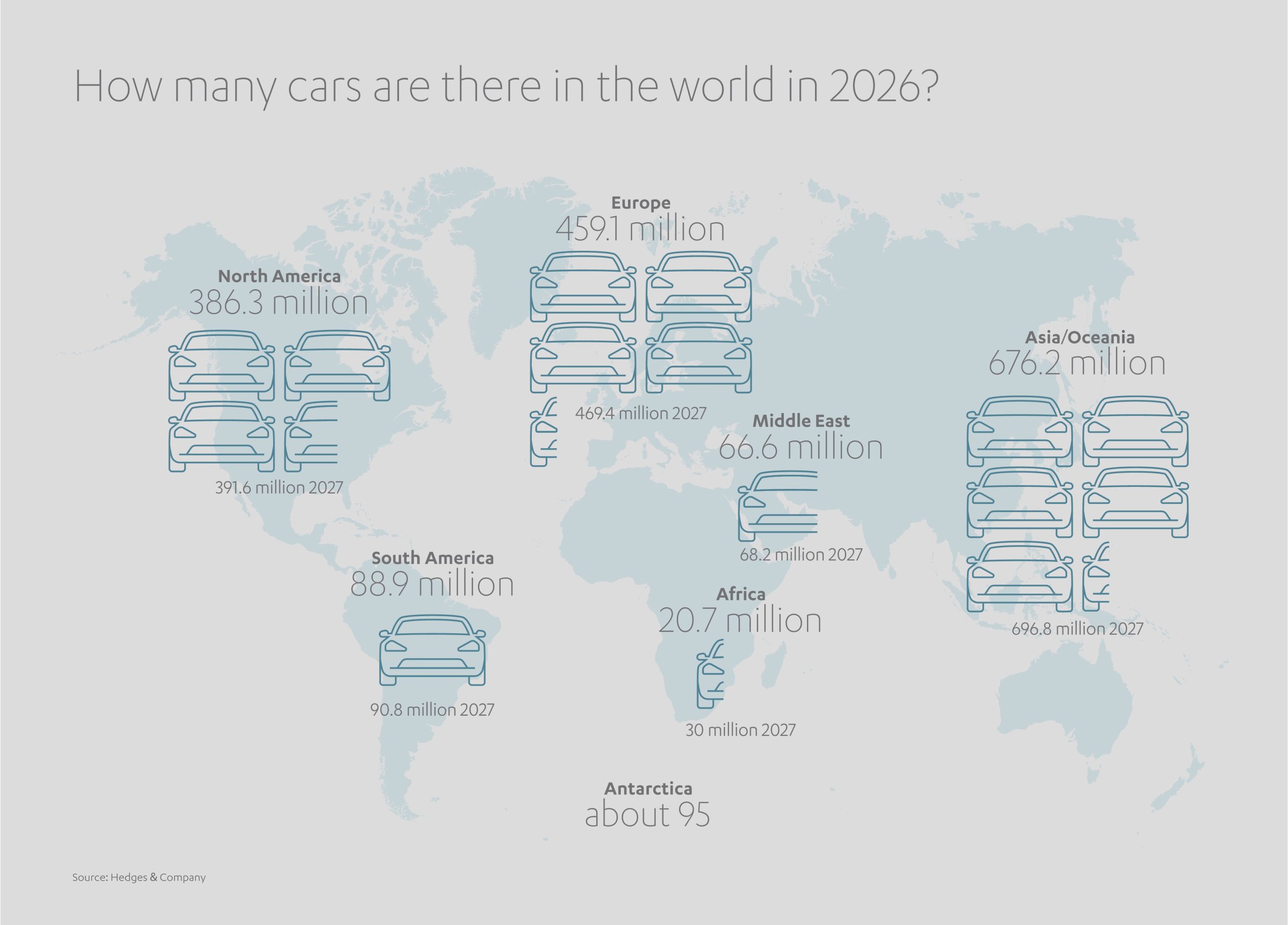
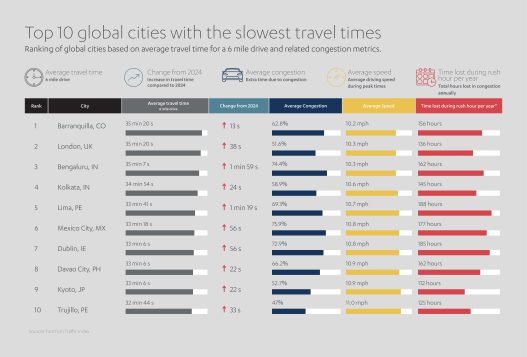
The impact of our vehicular addiction is inevitable. Current transport networks display signs of overload and stress, with dire time and cost impacts. In London, UK, one of the world’s most congested cities, studies show the average driver spent six days stuck in transit in 2025.[3] Travelling one kilometer in London took an average of three minutes and 38 seconds in 2025 – a four second increase in the space of a year. Colombia’s Barranquilla, India’s Bengaluru and Kolkata, Ireland’s Dublin, Mexico City, Peru’s Lima and Trujillo, the Philippines’ Davao City and Japan’s Kyoto also ranked within the world’s top 10 congestion hotspots.
Pressure is growing to modernize urban transport and liberate our cities to become the kind of economic powerhouses that can sustain nations
Expanded globally, such logistical inconveniences swell into considerable financial burdens. Time wasted due to urban congestion costs the global economy an estimated US$ 500 billion each year.[4] As the cost of living continues to rise, and as governments struggle to fund projects for countering climate change, pressure grows to modernize urban transport and liberate our cities to become the kind of economic powerhouses that can sustain nations.
AI can assist in two ways:
- By helping us design integrated transport networks fit for the future
- By controlling their daily operations once active
How can AI help design future mobility networks?
Automated systems can help run complex mobility systems with minimum downtime and delays. Yet before a single wheel has turned, AI-driven predictive analysis software can ensure we design the right transport networks in the first place.
With unprecedented accuracy, AI modelling tools are beginning to interpret how and why people and goods navigate cities. From a planning perspective, AI can blend data on current urban mobility use with long-term socio-demographic trends to forecast future demand.
It can go even further, simulating the likely impacts of various infrastructure and policy choices on future travel patterns. These insights can guide decision-making and ensure smarter investment choices.
CASE STUDY: BOSTON – In Boston, USA, the Office of Emerging Technology has launched its AI-driven Curb Lab to dynamically manage parking and cut queue times. Current initiatives include live congestion monitoring, real-time tow-zone alerts, priority safe passage for food delivery services, and publicly accessible maps to help drivers find parking. Crucially, the system makes information about parking rules, loading zones and time restrictions available through apps that residents and businesses already use, such as sat-navs and delivery platforms.
Many questions face transport planners, all with expensive, high-stakes outcomes, such as:
- Does a train network need a new station to serve a growing commuter suburb?
- Is a proposed park-and-ride site in the most convenient spot for drivers?
- Does an overcrowded tram route require a parallel line?
- What about new bus stops and interchanges to mirror changing footfall?
- Or new charging points for electric buses and e-bikes?
- Will car-free zones do more economic harm than good?
In each case, decisions are long-term and costly commitments. The rewards for success are high, but so too the price of mistakes. With their astonishing logarithmic and machine learning capacity, modern AI-led systems can provide macroscopic models of transport networks and customer demand. They can help cities develop mobility strategies not just for today and tomorrow, but for the decades ahead.
Insights provided can include:
- Comprehensive maps: Detailed diagrams of bus, tram, subway, taxi and train systems, for a comprehensive city-scale perspective of public transport.
- Simulated traffic impacts: Estimates of disruption caused by new transport construction projects, limiting the immediate impacts of building a better future.
- Scenario planning: Forecasting the collective city-wide impacts of new public transport routes, zoning policies or transit investments, while ensuring every dollar spent brings maximum returns.
- Multimodal transport modelling: Ensuring cities balance the right mix of public and private transport in its many forms, extending benefits across entire regions.
- Accommodating changing land use: Simulating the likely mobility impacts of new developments such as housing estates, retail parks or office blocks, anticipating changing transport demand.
- Universal access to data: Providing a common interface for multiple stakeholders in the transport value chain to submit and analyze data.
- Sustainability metrics: Combining traffic data with climate data from emissions sensors and weather monitoring stations, so that transportation plans complement decarbonization goals.
CASE STUDY: DUBAI – The Dubai Roads and Transport Authority (RTA) in the UAE has joined forces with South Korea’s Nota AI on an Intelligent Transportation System (ITS). Nota’s Vision Agent software is a traffic management product using vision language model (VLM) technology. With round-the-clock visual analytics, the cameras are designed to improve traffic flow by reducing bottlenecks. They can also identify hazards unfolding on Dubai’s roads in real-time and trigger emergency responses when needed. AI also creates analysis reports automatically, saving human labor.
AI can also help improve access to mobility – a key requirement of fairer, sustainable transport systems.
Advanced modelling techniques can provide up-to-date analyses of how different social groups access the transport network, identifying any neglected districts and highlighting common barriers to usage. By predicting how populations will evolve in the short- and medium-term, AI can focus funds on areas facing a public transport deficit. It can ensure that lower-paid key workers are provided for and that everyone, irrespective of socioeconomic class, can access the fundamental rights of jobs, healthcare and education.
Once a newly configured transport network is up and running, AI can continue to play a central role in urban mobility. Increasingly, it is capable of overseeing the minute-by-minute operation of a city’s entire traffic ecosystem.
How can AI improve city traffic management?
Spend much time in a city and one quickly appreciates the fragility of our transport systems. A tube train breaks down in a tunnel causing network-wide stoppages; bad weather blocks a key artery in or out of the city; a bus avoiding planned roadworks causes tailbacks on an already-busy side street. These problems typically cascade as commuters seek alternative transport as their preferred modes fail. Before anyone knows what has happened, a whole swathe of a city can be in logjam.
Incidents such as these occur because different modes of transport are generally coordinated by different sets of people working within their own data niches. An overarching AI system, on the other hand, would be able to take a city-wide overview of transit flows and improvise solutions which cause the least delays to the fewest number of people.
CASE STUDY: YORK – York is the first city in the UK to embrace predictive modelling for live traffic management. Part of the Smarter Travel Evolution Program (STEP), the project replaces the previous system of CCTV monitoring and manual signage changes. It combines dynamic transport models with live data from more than 100 traffic flow sensors, alongside information about roadworks and other disruptions. Operators can test different scenarios to ensure optimal traffic flow hours or even weeks ahead, with the outcomes being used to hone future responses. Managers can now react swiftly to queues, accidents or fluctuating demand, cutting journey times while simultaneously reducing emissions from idling vehicles.
Modern AI-infused transport systems have wide-ranging scope as well as impressive computational power. They can generate short-term traffic forecasts, minutes or even hours ahead of time. They can test responses to unforeseen events, such as breakdowns, and evaluate which of multiple scenarios will have the least impact. They can optimize networks in real-time, either by controlling traffic signals and lane priorities, or by adjusting the speed of trains or trams to stagger arrival times. They can even intervene to adapt timetables and ensure synchronized services.
In many cases AI tools integrate seamlessly with existing infrastructure, bringing dynamic traffic control and incident management within reach of many urban hubs.
What are the current limitations of AI in transport planning?
Artificial intelligence promises to transform traffic management in several key ways:
- Designing versatile mobility systems
- Coordinating increasingly complex multimodal networks
- Forecasting congestion and tailbacks
- Optimizing signal timings and digital signage
However, for AI to make a dramatic difference to urban mobility, a number of key challenges remain.
Any system is only as good as the data upon which it feeds. Outdated or incomplete traffic data can lead to poor predictions and flawed operational decisions. Unexpected events, such as extreme weather, infrastructure failures or public gatherings, can overwhelm models trained solely on historical patterns.
Cities must also confront financial barriers. AI-enabled transport systems require costly upfront investment, with extensive digital equipment such as connected sensors, cameras and communications. These can prove prohibitively expensive, particularly for lower-income regions.
Bolting AI platforms on to redundant infrastructure is likely to cause compatibility problems and chronic underperformance. Investing in AI, therefore, can in some circumstances also mean investing in new infrastructure.
In this scenario, AI should become a support tool rather than a replacement for human judgment.
Questions also arise over transparency and public trust. Many advanced AI models are ‘black box’ systems, making it difficult for planners to understand the logic behind particular decisions.
Concerns surrounding cybersecurity and data privacy further complicate deployment, especially where automation influences emergency services and public safety.
Case study: Singapore’s AI-powered transport transformation Singapore is investing US$ 630 million over the next five years to integrate AI systems into land, sea and air mobility networks as part of a wider Future of Transport plan announced in 2026. AI and automation are expected to make train and bus services more reliable and enable faster recovery from disruptions, supported by fully automated subway depots that maintain trains more effectively and AI sensors and drones carrying out routine infrastructure inspections once done manually. The same principles extend to sea and air. At sea, AI, robotics and autonomous technologies will help ports move cargo more efficiently and keep global trade flowing, promising more reliable supply chains and goods reaching Singapore more quickly. In the air, an AI-enabled air traffic management system is designed to better match flight demand with airport capacity, cutting congestion and delays, meaning faster check-ins, fewer delays and smoother airport journeys. With transport contributing roughly 10% of GDP and 7% of jobs nationally, Singapore’s approach focuses on layering AI onto existing urban transport networks to improve reliability and resilience for commuters.
In the future, the most resilient transport systems will probably combine intelligent automation with experienced planners capable of interpreting local conditions. In this scenario, AI should become a support tool rather than a replacement for human judgment.
Given these conditions, what should city planners, mobility chiefs and technology teams be focusing on to maximize the potential of AI in transport systems?
What are the priorities for integrating AI into transport planning and management?
Successfully integrating AI into transport systems requires more than investing a large sum of money and hoping for the best. Instead, it demands careful planning and continuous oversight.
The International Transport Forum’s Mobility Innovation Hub makes a number of key recommendations[5] for city planners considering incorporating AI technology into their transport planning and management systems.
- Gauge AI suitability: AI is not always the correct solution, being highly dependent on factors such as data quality, organizational capability and budget availability. AI should not be used as a costly sticking plaster for embedded deficiencies. Planners should always consider whether conventional approaches could deliver better outcomes.
- Pick the right system: Different applications require different models, so authorities should ensure that candidate technologies match local priorities and desired outcomes.
- Start small: Authorities should begin with limited, low-risk pilot projects that allow AI apps to be tested and refined before wider deployment. Small-scale trials can help build technical expertise while minimizing disruption if systems fail to perform as expected.
- Establish clear governance: AI should reflect principles of transparency, accountability and long-term resilience, matching the public-service responsibilities of transport authorities rather than commercial objectives.
- Monitor performance: Planners must remember that AI deployment is never ‘complete’. Ongoing evaluations are essential to ensure systems remain accurate and aligned with changing transport needs. If performance deteriorates, authorities should be prepared to reintroduce the human factor into analytical and decision-making processes.
By following these doctrines, AI can help steer us from a future of traffic-clogged cities to a more utopian ideal – one of free-flowing traffic and smart, green, interconnected public mobility.
How might AI-infused traffic planning evolve in the future?
Imagine a city where traffic no longer becomes gridlocked because roads, cars and transport interchanges are constantly communicating. That is the promise of citywide AI transport management systems.
Many elements of this future are already emerging. Singapore is using AI to optimize traffic flow and support its smart city planning. Since launch, rush hour hold-ups have fallen by 20%, while peak time travel speeds have increased 15%.[6]
In China, Hangzhou’s City Brain platform is demonstrating how machine learning can decrease congestion by coordinating traffic signals across entire districts. Since its introduction, Hangzhou has gone from being the 2nd most congested city in China to the 34th, while also cutting the number of accidents.[7]
Already AI is scrutinizing data from cameras, vehicles, weather stations and road sensors to predict tailbacks before they happen, then adjusting traffic signals, speed limits and schedules to fit. But the AI-enabled city of tomorrow could take these ideas further.
“The smartest cities will not simply use more AI – rather, they will deploy it more wisely, and always in service of a city’s inhabitants”
Public transport, freight logistics, emergency services and EV charging networks might eventually operate as one integrated ecosystem, shortening journey times. Digital twins could allow planners to test new infrastructure ‘virtually’ prior to construction. Predictive analytics could identify maintenance needs before failures emerge.
A modern city should operate like a healthy organism, with roads and other transport links serving as free-flowing veins and arteries. Realizing this vision will require both thoughtful governance and technological innovation. The smartest cities will not simply use more AI – rather, they will deploy it more wisely, and always in service of the people who live there rather than the technology itself.
AI IN TRANSPORT NETWORKS – FIVE FAST FACTS:
Q: How much do transport delays cost cities financially?
A: Time wasted due to urban congestion costs the global economy an estimated US$ 500 billion each year.
Q: How many vehicles are on the world’s roads today?
A: About 1.7 billion vehicles, a figure tipped to rise to 1.738 billion in 2027.
Q: How much time do drivers in London lose to congestion?
A: In 2025, the average London driver spent six days stuck in transit, as one kilometer took an average of three minutes and 38 seconds to travel.
Q: What impact has AI traffic management had in Singapore?
A: Since launch, rush hour hold-ups have fallen by 20%, while peak time travel speeds have increased by 15%.
Q: How has AI changed congestion rankings in Hangzhou, China?
A: Since introducing its AI-powered City Brain platform, Hangzhou has gone from being the 2nd most congested city in China to the 34th, while also cutting the number of accidents.
[1] https://www.statista.com/statistics/262747/worldwide-automobile-production-since-2000/?srsltid=AfmBOoqdTTODSqbVigKP1JFhTmVhMjTRzLpakUKChRI_pg2lOQlOdWB2
[2] https://hedgescompany.com/blog/2021/06/how-many-cars-are-there-in-the-world/
[3] https://media.tomtom.com/f/178460/x/0351ad0747/tomtom-traffic-index-united-kingdom.pdf
[4] https://www.oliverwyman.com/middle-east/our-expertise/insights/2026/jan/how-the-middle-east-can-beat-its-traffic-crisis.html
[5] https://www.itf-oecd.org/sites/default/files/repositories/ai_use_by_transport_authorities_handout.pdf
[6] https://www.earthday.org/smart-cities-green-futures-how-ai-is-powering-urban-sustainability/
[7] https://www.pacificresearch.org/freedom-v-efficiency-hangzhous-city-brain-can-improve-efficiency-but-raises-many-questions/
[GC1]Link to recent MaaS article once published


 Dubai, United Arab Emirates September 21 , 202620 minute read


