


 Rome, ItalyMarch 18 , 2026
 11 minute read
Is the Italian auto market accelerating into the future?
Rome, ItalyMarch 12 , 202611 minute read
Part 1 of a Q&A with Marco Santucci, Managing Director, Jameel Motors Italia, on opportunities and challenges in the Italian automotive market
Italy has a rich and celebrated history in the automotive world, homegrown marques like FIAT, Lancia, Alfa Romeo, Ferrari, Lamborghini and Maserati synonymous with industrial innovation, performance and design. Italy’s northerly Emilia-Romagna region has long been considered a global hub for supercars, rightly earning itself the epithet ‘Motor Valley’.
More recently however, the Italian automotive industry has been at less than full throttle. Manufacturers weathered a 6% fall in revenues in 2024 and a corresponding 20% dip in profits as fewer new vehicles rolled off factory lines.[1]
The year 2025 was equally uncertain. Car production in Italy hit its lowest level in a quarter of a century, with unit numbers predicted to show a 4% decline on the previous year.[2] Industry anxiety peaked in the summer, with just 132,000 new cars registered across the country in June, a 17.4% decline year-on-year.[3]
That statistic marks a worrying downturn, but what are the underlying causes?
One of the reasons suggested is that Italian authorities have been slow to respond to changing customer habits. Summer 2024 saw the launch of Italy’s Ecobonus scheme to incentivize the switch to low-emission vehicles. The strategy boosted orders in the short-term but became a victim of its own success, with the fund for fully-electric cars exhausted on day one. It has yet to be replaced by a cohesive alternative.
While car sales are down overall, key trends are discernible.
Budget-conscious customers in Italy continue to focus on more affordable, compact vehicles, especially given recent price rises across the industry as a whole. Pre-pandemic, the average new car in Italy cost around €21,000, but by 2024 this had risen almost 50% to €30,000.[4]
With these harsh new financial pressures, Italian car buyers are increasingly looking beyond domestic manufacturers when purchasing vehicles.
Although the locally-produced FIAT Panda remains the best-selling model in 2025, with a 7.1% market share, it is the only Italian-made car in the country’s top 10.[5] The most popular alternatives are all foreign marques: Dacia’s Sandero and Duster (Romania, but part of Renault), the Jeep Avenger (USA, but part of Stellantis), the Citroen C3, Peugeot 208 and Renault Clio (all French), the Toyota Yaris (Japan) and the MG ZX (China).
Climate change matters, too. Extreme weather events such as floods and landslides are increasingly a feature of life in southern Europe. Italians, like everyone else, are conscious of the looming environmental crisis and the need to relegate fossil fuels to the history books.
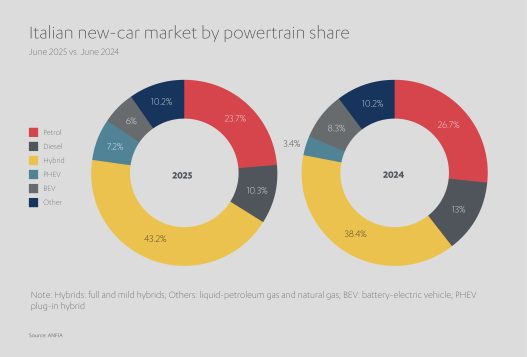
Correspondingly, the proportion of green vehicle sales is growing. Hybrid vehicles, along with plug-ins (PHEVs) and battery EVs (BEVs), together account for 56.7 % of all new car sales in Italy during 2025, a rise from last year’s 50.1%. The opposite is true for purely petrol and diesel-driven vehicles, falling from 39.7% to 34% over the same period.[6]
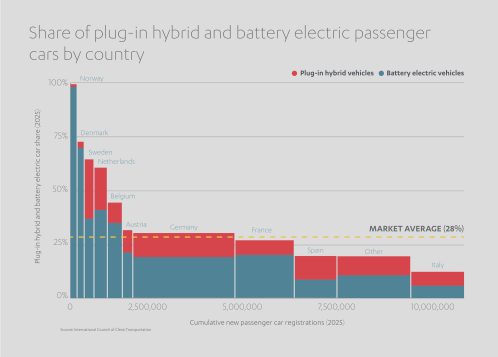
Although a national preference for greener vehicles is slowly emerging, Italy has, until more recently, appear to have been more resistant to transition than many of its European counterparts. In 2025, combined battery electric and plug-in hybrid vehicles accounted for 28% of new car registrations across Europe. Italy remained well below this European average, and far behind leading markets such as Norway (97%), Denmark (71%), Sweden (63%) and the Netherlands (59%)[7]
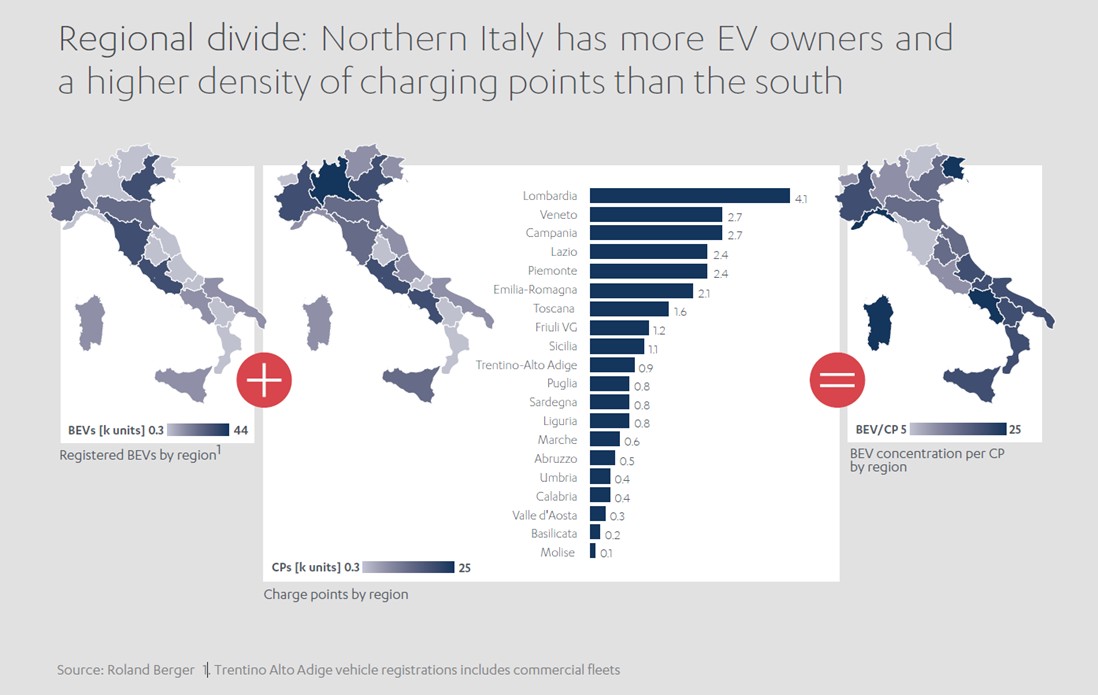
Part of the problem may be cultural. Cars as a symbol of status, not to mention speed and performance are central to Italy’s proud motoring legacy and Italian suppliers remain inherently wedded to traditional internal combustion engine (ICE) technologies. Underdeveloped carriageways also leave a proportion of customers reliant on heavy-duty and off-road vehicles, which are more difficult to electrify. Compounding these problems, Italy lags behind in the development of EV infrastructure, especially in its central and southern regions. Across the country as a whole Italy can claim only five charging points per 100 km of road, a fraction of the European average of 27 per 100 km.[8]

Managing Director, Jameel Motors Italia
With demand for ICE components in Italy forecast to halve between now and the end of the decade – and with electric powertrains expected to surge 30% over the same timeframe – every stakeholder along the Italian auto supply chain must start to move with the times and adjust to changing priorities.[9]
Marco Santucci, managing director of Jameel Motors Italia, is starkly aware of these dynamics.
Jameel Motors recently signed a distribution agreement with Chinese carmaker Geely Auto to launch the all-electric Geely EX5 and Starray EM-i super-hybrid within Italy – a new European territory for both partners.
Here, Marco shares his insights into the Italian auto industry and the company’s plans for developing its presence in the market.
Marco, studying the profile of the Italian auto market today, what trends can we discern?
In 2026 we have witnessed a growth of more than 10% in the Italian market but mainly driven by Fleet, RAC and OEM registrations.
Italy would benefit by promoting electrification through incentives, by opening new avenues of funding for charging networks, and by adopting stricter emission rules. This would help to bring the country in line with EU environmental targets. By holding back the market and resisting these trends, the government is only causing confusion.
What has caused these bumps in the road?
Lack of foresight has hurt the Italian auto market. Italian brands were faced with the option of either sacrificing quality or increasing prices to keep pace with evolving technology. Mass-market cars like FIATs are becoming too expensive in relation to alternatives offered by Chinese rivals. There is a mismatch between the direction of the market and the investments being made in production and product pipelines. This is what is causing the situation we see today.
How successful is China being in penetrating the Italian auto market?
The biggest Chinese car manufacturer, SAIC Motor Corp, is fast emerging as a major player in the market. SAIC is introducing vehicles under the MG banner, a historic marque of British origin which it now owns. Last year they have sold around 50,000 cars, which is a huge number. Majority of these sales have been traditional ICE-driven cars. They are succeeding simply by meeting customer demand for quality, low-cost cars.
This is very important for the market, because what they are really doing is promoting wider acceptance of Chinese cars and establishing a reputation for value and reliability. Therefore, as they gradually start to introduce more new energy vehicles (NEVs) into the marketplace, customers will be ready and willing to consider them as a valid alternative.
A second Chinese auto giant, BYD, has taken a rather different strategy, offering PHEV and BEV models straight away. BYD is choosing a very aggressive pricing strategy to attract the cost-conscious. They have also been focusing on selling large numbers of company fleet cars to raise their profile and further normalize the concept of Chinese autos. So although the Italian auto market, as a whole, has been sluggish, Chinese brands are bucking the recent trend.
What are the wider implications of the success of Chinese brands?
Effectively, the market is now operating at two different speeds. Sales of Chinese cars are gaining momentum, and I have no doubt that trend will accelerate further and faster. Over time, Chinese brands will claim an ever-greater market share. Whether they will reach the 10%-20% threshold it is too early to say, but they will certainly climb dramatically in a relatively short timeframe, say the next two or three years.
Competition is intense. Chinese manufacturers are attacking the market vigorously, using big discounts to lure customers. Legacy domestic brands are left to pursue other strategies that might accidentally backfire in the longer term, like using cheaper components, which if they are not careful can incur reputational damage. They are also attempting to lobby government to limit interventions such as EV incentive schemes, but ultimately this may just be a futile bid trying to hold back the inevitable tide of new technology.
As Jameel Motors Italia and Geely Auto start to build their presence in Italy, what is your strategic vision for establishing a foothold and capturing market share?
With acceptance of Chinese brands growing swiftly, we believe we have the perfect combination of the right product, at the right time, right place and importantly, at the right price.
Our pitch is quite simple: We are positioning ourselves as a higher quality alternative to rival brands. We want to avoid huge discounts and widespread price warfare. Instead, we aim to gain a reputation for dependable, innovative AND durable technology. As an example, one of our early marketing pitches was to offer a lifetime warranty for our first 1,000 customers. That instantly created a lot of interest among the public, with everyone discussing in the press and on social media how Geely vehicles must have exceptional build quality. This is our proposition, and we are confident buyers will respond positively.
How does your vehicle line-up complement this vision?
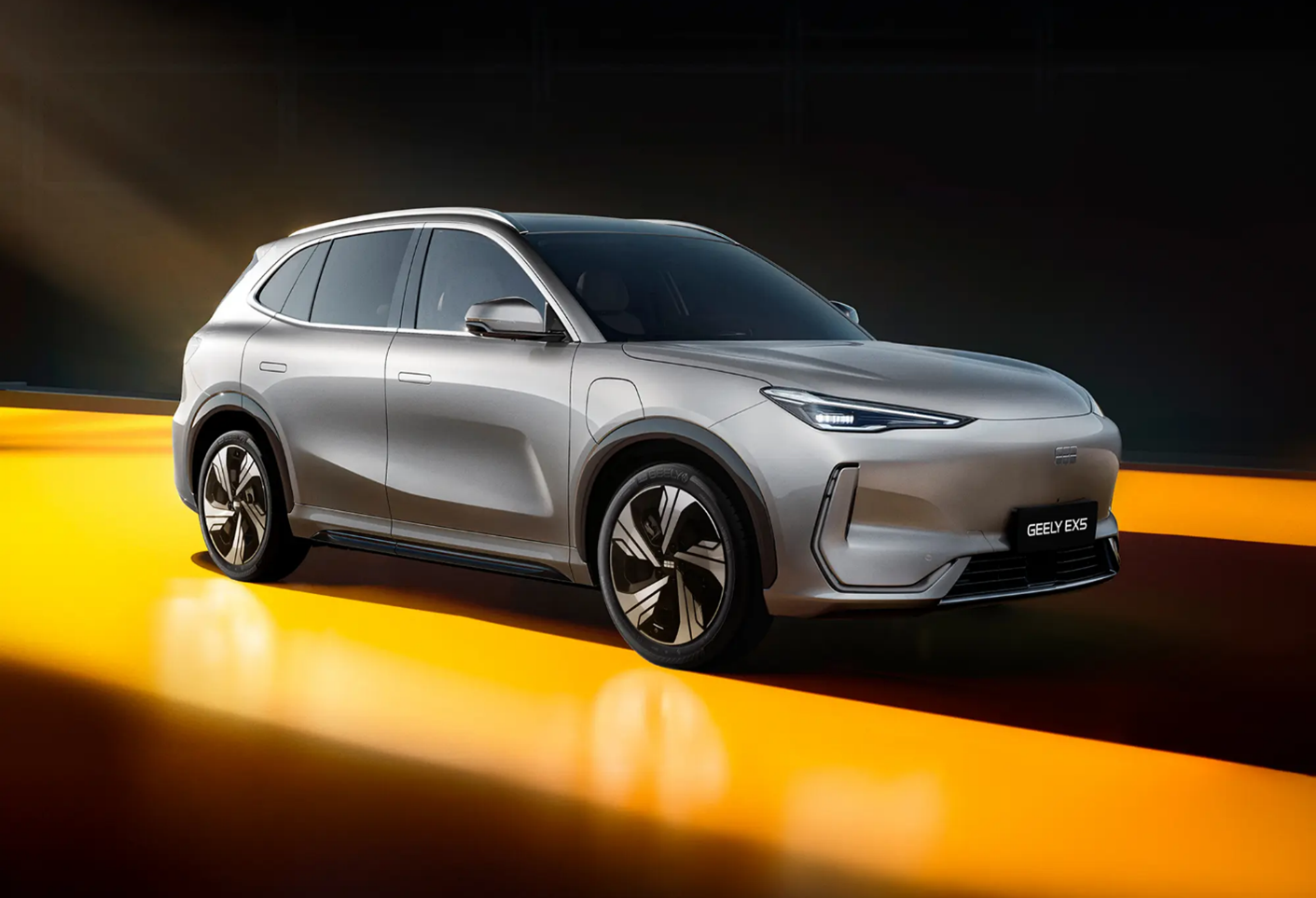
Presently we have two models, both compact SUVs, one electric – the Geely EX5 – and one PHEV – the Starray EM-i.
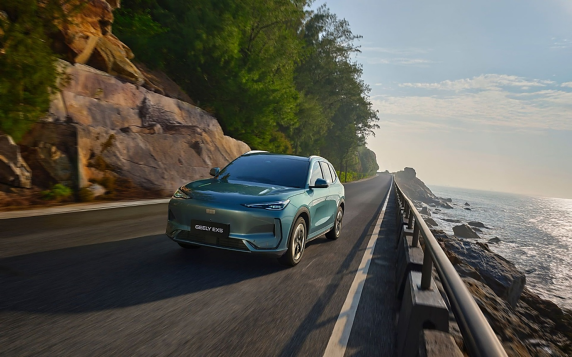
The SUV segment currently represents around 10% of the total market, but we are hoping to triple it to around 30%. Beyond that we will need to expand our offering of powertrains and models. Further down the line we hope to offer more exciting new energy brands.
Fundamentally, we are committed to clean energies and to greening the mobility sector. I can say with confidence that we are winning that broader messaging battle. Plug-in hybrids, for instance, are now able to offer driving distances of up to 1,000 km, which is opening up the technology to huge numbers of people who might once have been deterred by ‘range anxiety’. Hybrids have wide appeal. Why? Because people appreciate the fallback option of being able to fill their cars with fuel for long journeys, or when driving through regions with fewer charging stations. Ethics meets practicality – it is a compelling concept.
What should we expect from the launch of the Jameel Motors Italia / Geely Auto partnership this year?
From our perspective we could not be more excited about our launch last year. We anticipated opening with around seven retailers, but we finished 2025 with more than 40 point of sales and we are now at 52 Sales and service points, so it has far exceeded our expectations. We already have tens of thousands of interest potential customers and more than 4,000 immediate test drive requests.
Also, one must appreciate the bigger picture: We are not just creating a network of dealers. We are building but more importantly a network of advocates. People who are genuinely passionate about creating this brand and shouting our message from the rooftops. It’s a very exciting time to be innovating in this market.
[1] https://www.strategyand.pwc.com/it/en/insights/automotive-supplier-market-in-Italy.html
[2] https://www.strategyand.pwc.com/it/en/insights/automotive-supplier-market-in-Italy.html
[3] https://autovista24.autovistagroup.com/news/worrying-times-for-the-italian-new-car-market/
[4] https://www.ilfattoquotidiano.it/2025/01/19/prezzo-medio-auto-aumento-ultimi-5-anni-mercato-usato-in-crescita/7834317/
[5] https://www.focus2move.com/italian-best-selling-cars/
[6] https://autovista24.autovistagroup.com/news/worrying-times-for-the-italian-new-car-market/
[7] https://theicct.org/publication/european-market-monitor-cars-and-vans-2025/
[8] https://www.rolandberger.com/en/Insights/Publications/EV-Charging-Index-Expert-insight-from-Italy-2024.html
[9] https://www.strategyand.pwc.com/it/en/insights/automotive-supplier-market-in-Italy.html



 Dubai, UAEDecember 9 , 202515 minute read


