


Are new energy vehicles set to electrify Italian car market?
 Rome, ItalyMarch 18 , 2026
 11 minute read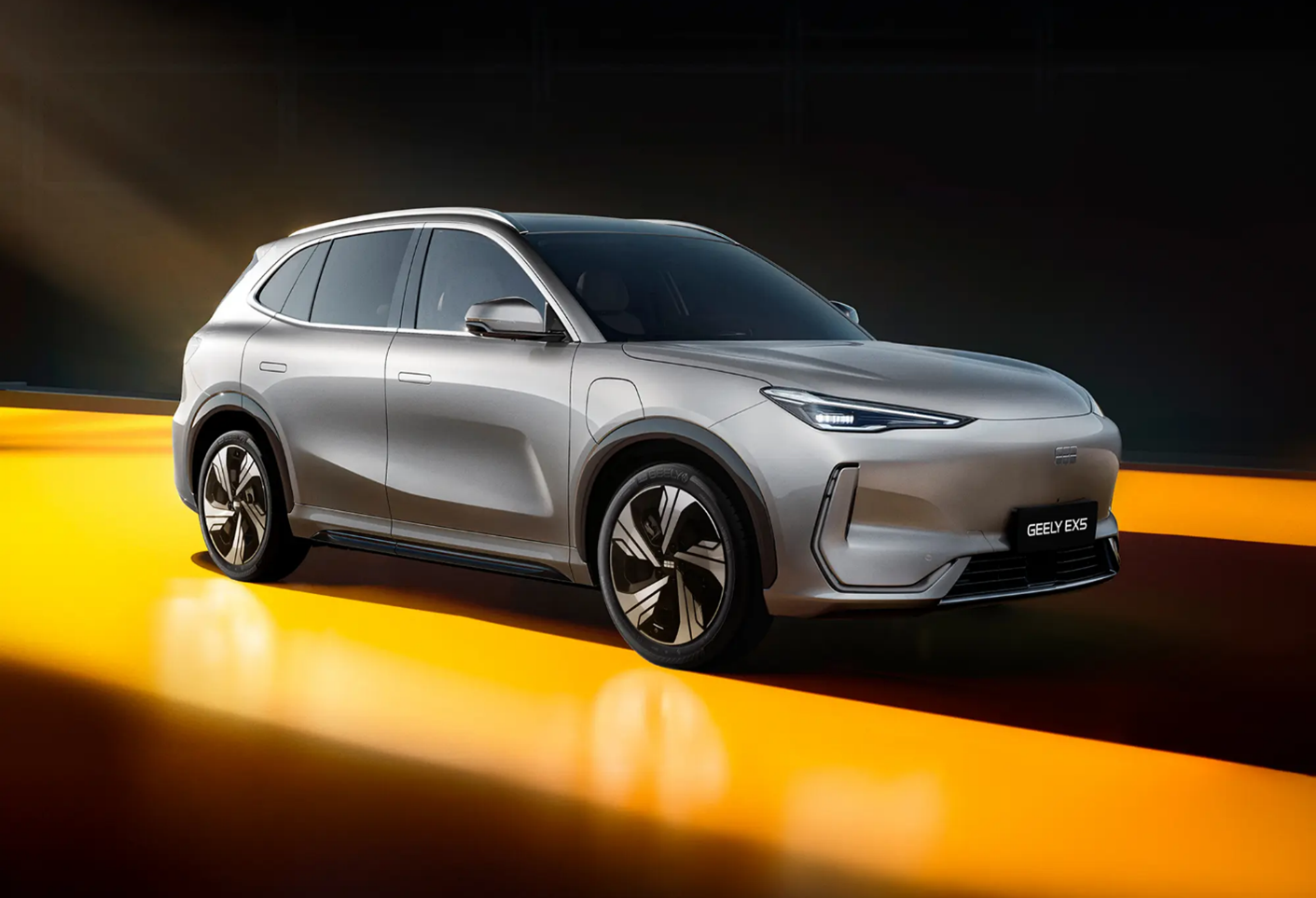
Part 2 of a Q&A with Marco Santucci, Managing Director, Jameel Motors Italia, on opportunities and challenges in the Italian automotive market
At first glance, the Italian auto industry appears to be, well . . . a little in the ‘slow lane’, with car production in 2025 hitting its lowest level in a quarter of a century[1]. Manufacturers faced a similar uphill struggle in 2024, with a 6% fall in revenues and 20% dip in profits from the previous 12 months. Such back-to-back downturns could be seen as a trend rather than an anomaly.[2]
A closer examination of the figures reveals more subtle messages, however, providing hope for the industry while positioning a fresh savior center stage: New energy vehicles.
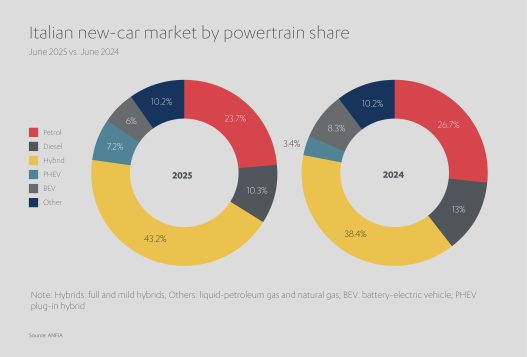
While the share of petrol and diesel-driven vehicles leaving salesrooms shrank from 39.7% to 34% in 2025, the proportion of hybrids, plug-ins (PHEVs) and battery EVs (BEVs) leaped from 50.1% to 56.4%.[3]
With warmer summers and a greater incidence of extreme weather events, Italians are brutally aware of the existential threat of climate change and are beginning to adjust their buying habits.
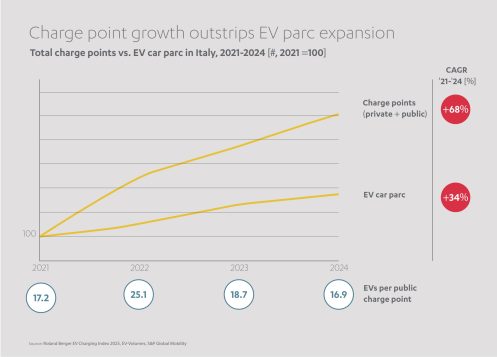
Fears over EV range anxiety and a lack of charge points are easing as the technology and infrastructure evolve. Some new PHEVs are capable of driving distances up to 1,000 km. Additionally, with a 28% growth in public charging infrastructure in 2024, Italy now claims one charge point for every 17 EVs. This marks an improvement from one charge point for every 19 EVs the previous year, although still slightly trails the European average of one for every 14 vehicles.[4]
How much is Italy investing in electric vehicle infrastructure?
This is only the start of a wave of investment in electric infrastructure. September 2025 saw the earmarking of €600 million within Italy’s National Recovery and Resilience Plan (PNRR) to promote the adoption of private and light commercial EVs.[5]
The fund, stretching until mid-2026, aims to replace around 39,000 internal combustion engine (ICE) vehicles with eco-alternatives. Families living within towns of 50,000+ inhabitants can receive up to €11,000 when scrapping an old fossil fuel-driven car and replacing it with a battery-driven model. Small businesses, meanwhile, can access rebates for 30% of the cost of buying new electric light commercial vehicles, up to a maximum of €20,000 per unit.
This stimulus package supplements a series of regional EV incentives, such as those found in Lombardy (€4,000 per car or €8,000 per van) and South Tyrol (€1,000 for PHEVs and €2,000 for BEVs). Other localized perks further reward motorists at the vanguard of the EV transition. EV drivers in cities such as Roma, Milano and Bologna, for example, can access free or discounted parking, as well as permission to enter restricted traffic zones.
The PNRR fund is set to provide an additional 27,000 charging stations across the country within two years.[6] Many of these will be cutting-edge DC charge points capable of fully charging a vehicle in as little as 15 minutes. Already the share of these ultra-fast chargers is rising across Italy, with 22% of public charge points now DC-equipped, up from 14% in the space of a year.[7]
What types of NEVs are most popular in Italy?
While the trend for new energy vehicles is curving upwards, the nature of those vehicles warrants a deeper probe.
During 2025 the share of hybrid vehicle sales stands at a promising 44.7%, up from 39.9% in the in 2024.[8] However, hybrids – as the name suggests – are sometimes powered by their ICE drivetrain, reducing their overall climate benefits. Pure EV sales in Italy reached 94,230 units in 2025, representing a 6.2% market share. While this marked solid year-on-year growth, it remained well below the European average BEV share of 19% for 2025. Manufacturers nevertheless remain optimistic, continuing to support and expand offerings across all segments of the EV market.
The bestselling pure electric models in Italy during 2025 are the Tesla Model Y, followed by the Fiat 500e, the Dacia Spring, SAIC’s MG4 and the Renault Megane E-Tech, mirroring the top sellers of 2024.[9] However, the market is braced for a raft of new options over the next decade, many of them originating from Italian carmakers.[10]
Alfa Romeo, despite reversing plans to go all-electric by 2027, is still working on new versions of its acclaimed Giulia saloon and Stelvio SUV models, likely to feature multiple powertrain options including electric and hybrid. Ferrari this year unveiled its new 296 Speciale and 296 Speciale A (convertible) rear-wheel drive PHEVs to satisfy the sportier end of the market. Looking ahead, its all-electric Ferrari F222 will enter production in 2026. Fiat is launching a new, larger version of its Grande Panda electric/hybrid car in 2026, with a new iteration of its smaller electric/hybrid Panda following soon after. Abarth (the high-performance division of FIAT) has indicated its pure electric 500e and 600e models are due for upgrades in 2026 and 2027 respectively, with brand new successors for both cars set for 2030 and 2031. Firmly pursuing the prestige segment, Maserati is expected to debut an electric SUV tentatively known as the ‘E-UV BEV’ in 2027 or 2028.
With public sector support and private sector innovation providing momentum, Italy’s EV sector is primed to shift into top gear. Little surprise, perhaps, that demand for electric powertrains in Italian vehicles is tipped to rise 30% between now and 2030.[11]
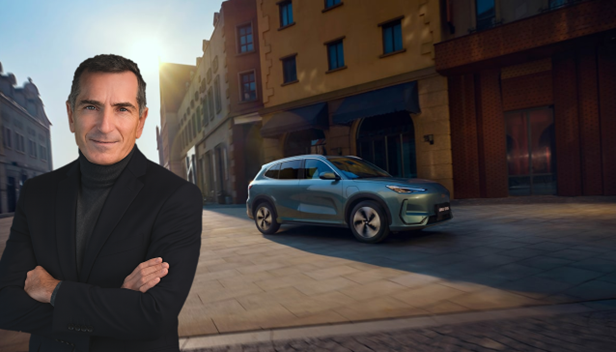
Against this exciting backdrop, Jameel Motors recently signed a distribution agreement with Chinese carmaker Geely Auto to launch the all-electric Geely EX5 and Starray EM-i super-hybrid within Italy – a new European territory for both partners. And in our second article in this series, Marco Santucci, Managing Director, Jameel Motors Italia, shares his own personal insights into the Italian EV industry and the steps necessary to further accelerate performance.
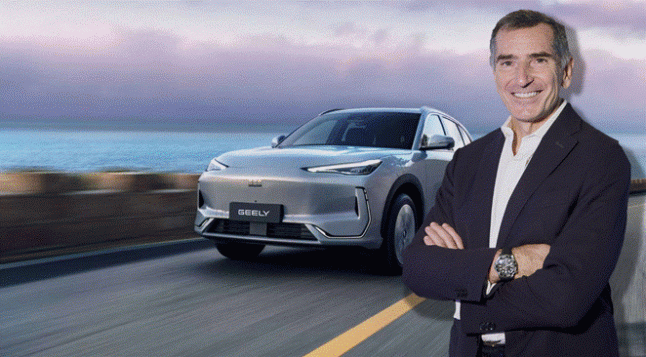
Marco, why is Italy playing catch-up with Europe in terms of EV adoption, and what can the government do to stimulate demand?
Everyone can see that the overall trend for the EV market is heading upwards, but in Italy we remain behind the times. EV adoption here in 2025 grew to 6.2% at year end and in 2026 YTD Feb reached 7.9% thanks to the EV incentives deliveries, but still low when compared to 15%-20% in France and Germany. Fundamentally, we need better planning.
The latest Ecobonus incentive scheme, originally launched by the government in October 2025, was somewhat limited in its design. It was restricted to low-income families in high-density areas, but people in this segment of the market are not viable candidates for early EV adoption. Despite this, the €600 million in support was booked in 24 hours since the launch, with 55,000 vouchers created to purchase EV cars making it clear that there is plenty of demand for cleaner vehicle technologies across the market as a whole.
Future support schemes must be much better planned and targeted – those funds need distributing more smartlypossibly in a continuous fashion, obviously with smaller contributions, but including early adopters and opinion leaders that can shape mindsets by being an example and avoiding this ‘on-off’ approach which only leads to more consumer and market confusion. The government is somewhat in denial over EVs being the future of motoring. Implying that the industry can continue with ICE technology is misleading, confusing, and holding back necessary progress.
From the customer perspective, what else is holding back the more rapid adoption of EVs?
There are a number of teething issues, some of which are perfectly understandable. Cars are expensive and people are sometimes wary of investing in a relatively new technology. For instance, they want to ensure the car they buy retains its value in the future, yet with so many variants available – hybrids, PHEVs, BEVs – they are worried about buying the wrong engine type.
Other people are concerned about recharging options, and the message has not yet filtered through that infrastructure shortfalls are fast being resolved. Compared to the number of electric vehicles on the road, Italy has a relatively large share of high-power DC charging stations. We need to communicate our strengths better to the average motorist to overcome such common misconceptions.
Equally, it is important to be honest and admit that we do lag behind a little in city charging. In big cities like Roma and Milano most people do not have garages and it is much more difficult to charge their cars. However, we will soon have technologies like we see in other major cities such as London, where people will be able to charge vehicles by plugging them into adapted lampposts. Overall, the message must be that our infrastructure is already good, and it is only going to get better.
Given the failures with the Ecobonus scheme, and consumer wariness about making the switch to NEVs, how do we account for the marked growth of EV sales within Italy?
The job of spreading the EV message seems to have fallen to the private sector. The government lacks motivation to hasten the switch to EVs because a high percentage of our GDP comes from domestic auto suppliers, which overwhelmingly remain rooted in traditional ICE technology. The government is afraid of people losing their jobs and impacts on GDP.
Chinese brands, relative newcomers to the Italian auto market, have embarked on huge marketing campaigns. This is why we are seeing Chinese EVs becoming increasingly accepted by consumers. Buyers are finally beginning to recognize that Chinese EVs provide exceptional value for money. They offer cutting-edge technology, broad choices and sophisticated support networks, all at accessible prices. Customers are ahead of the government on this one.
PHEVs are playing an important role as a technological stepping-stone. Once customers recognize the simplicity and economy of running hybrid cars on electricity, they will gladly shift to full BEVs upon subsequent purchases.
That is why, looking towards the future, we have so much confidence in EV technology. People are learning, correctly, that EVs require less maintenance and are cheaper to run than fossil fuel alternatives in the long-term. Upfront purchase price is merely one piece of a more nuanced picture.
Do you see trends in the Italian car market complementing wider efforts to put the nation on a more sustainable mobility footing?
Absolutely. I see Jameel Motors Italia at the vanguard of a wider move to establish Italy as a sustainability leader in Europe. If we are pushing for the electrification of mobility, we must ensure that the electricity we use is generated from the most sustainable sources. Don’t forget, we have plentiful hours of strong sunshine, we’re surrounded by water, and we have lots of wind, so at the macro level we need to start focusing on renewable energies.
This kind of joined-up thinking makes a compelling environmental and economic case.
If we can establish ourselves as an eco-nation then cars can form a core part of that revolution. They did it in Scandinavia, so why cannot we achieve the same here?
Stronger public sector support would be helpful. It would be encouraging, for example, to see the government offer 100% tax rebates on new energy vehicles for corporate customers. That would certainly convince many wavering companies to switch over their fleets and feel the long-term benefits.
We could also consider subsidizing businesses to install charging stations on their premises. Similar support schemes are needed for solar panels to generate clean energy on a larger scale. At present there is too much red tape and bureaucracy, with solar applicants needing to source permission from multiple levels – local, regional and central. Beyond that, we need smarter integration with energy networks for feeding surplus electricity into grids. We need to shorten the lead times for new energy projects too so that stakeholders can monetize progressive investments more rapidly. This is the best route to the future of motoring: Everyone across the value chain working together towards the same goals and outcomes, for universal benefit.
[1] https://www.strategyand.pwc.com/it/en/insights/automotive-supplier-market-in-Italy.html
[2] https://www.strategyand.pwc.com/it/en/insights/automotive-supplier-market-in-Italy.html
[3] https://autovista24.autovistagroup.com/news/worrying-times-for-the-italian-new-car-market/
[4] https://www.rolandberger.com/en/Insights/Publications/EV-Charging-Index-2025-Expert-insights-from-Italy.html
[5] https://alternative-fuels-observatory.ec.europa.eu/general-information/news/italy-launches-new-ev-incentive-programme-offering-eu20000
[6] https://www.zoniq.io/post/italy-ev-charging-landscape-in-2025-challenges-and-opportunities
[7] https://www.rolandberger.com/en/Insights/Publications/EV-Charging-Index-2025-Expert-insights-from-Italy
[8] https://www.ecomotorsnews.com/italy/electromobility-in-italy-a-two-speed-transition
[9] https://www.ecomotorsnews.com/italy/electromobility-in-italy-a-two-speed-transition
[10] https://www.just-auto.com/analysis/stellantis-future-models-2025-2035-part-1/
[11] https://www.strategyand.pwc.com/it/en/insights/automotive-supplier-market-in-Italy.html


 Rome, ItalyMarch 12 , 202611 minute read


